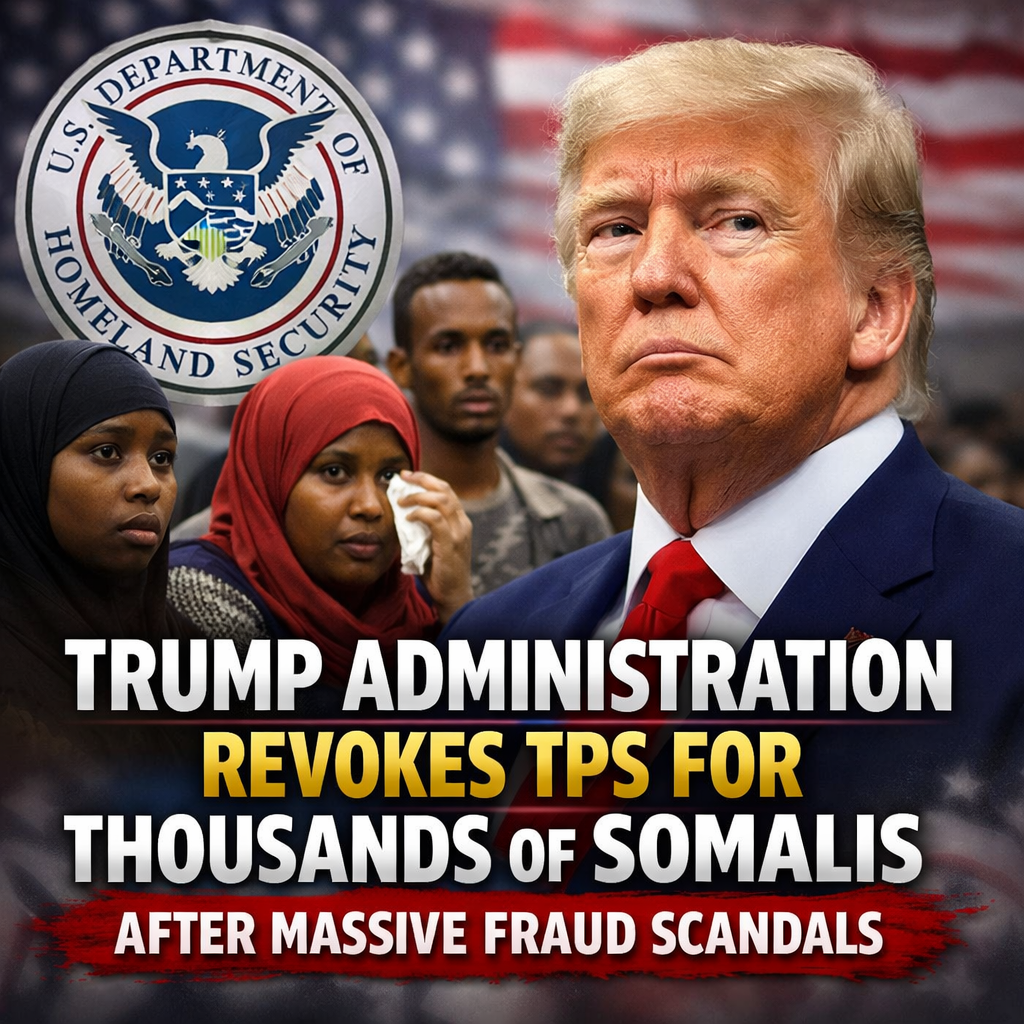
Trump Administration Revokes TPS for Thousands of Somalis After Fraud Scandals Shake Policy
The Biden administration’s humanitarian immigration policies suffered another reversal this week as the Trump administration formally revoked Temporary Protected Status (TPS) for Somali nationals living in the United States, a highly consequential shift in immigration enforcement that affects thousands of foreign-born residents and further underscores the administration’s prioritization of national sovereignty and public integrity.
The Department of Homeland Security (DHS) announced Tuesday that the TPS designation for Somalia — originally granted by Presidents Bush, Clinton, Bush 43, Obama, and subsequently extended under President Biden — will terminate on March 17, 2026. Nationals of Somalia currently residing in the U.S. under TPS must either depart the country by that date or risk removal proceedings absent other legal status.
Secretary of Homeland Security Kristi Noem stated that conditions in Somalia have improved sufficiently to no longer meet the statutory criteria for TPS, a position grounded in her interpretation of the statute and in review of international conditions. “Temporary means temporary,” Secretary Noem emphasized in a public statement, underlining the administration’s view that extended humanitarian protections should not become open-ended residency.
While exact figures differ among reporting sources, DHS officials acknowledged that roughly 1,100 Somalis currently hold active TPS protections, with approximately 1,400 more applications pending at the time of the announcement. This places the total directly affected population in the low thousands.
The move follows months of concentrated federal attention on Minnesota, home to the largest Somali diaspora in the United States, where the Trump administration surged federal immigration enforcement personnel amid major fraud investigations into childcare programs and other public benefits. Trump administration officials contend that abuses of government programs contributed to law enforcement decisions and underscore the need to enforce immigration laws rigorously.
President Trump himself has publicly linked the TPS termination to broader concerns about accountability and the integrity of public assistance programs. He also indicated a willingness to pursue denaturalization for naturalized citizens convicted of fraud, although the legal feasibility of such measures remains contested in legal scholarship.
Many conservative policymakers argue that the revocation of TPS for Somalis is consistent with the rule of law and with the constitutional prerogative of the federal government to control immigration. They assert that granting and indefinitely renewing TPS undermines the legislative intent of the program and erodes public confidence in immigration systems. Already, Republican lawmakers in the House have introduced complementary measures to terminate TPS for other nationalities and enforce self-deportation if necessary.
Critics, including progressive advocacy groups and civil liberties organizations, have decried the decision as discriminatory and dangerous, asserting that Somalia remains unstable with ongoing militia activity and humanitarian crises. These voices warn that prematurely returning vulnerable individuals to conflict zones could endanger lives. “This decision does not reflect changed conditions in Somalia,” said a representative of the Council on American-Islamic Relations.
Yet the Trump administration has asserted that improvements in security and governance in certain regions of Somalia render the generalized humanitarian protection unwarranted under the statutory TPS framework — which was instituted in 1990 to provide short-term refuge from extraordinary situations. Critics of the revocation insist that elements such as al-Shabab insurgency and economic instability persist, but DHS maintains that those conditions no longer justify blanket TPS designation.
Legal challenges are expected now that DHS has formally issued notice of the revocation. In past efforts to end TPS protections for other nationalities — including Venezuelans and Haitians — courts have at times blocked or delayed revocations on procedural grounds. Observers expect similar litigation around the Somali case, potentially citing administrative procedure concerns or alleging arbitrary decision-making.
Supporters of the administration’s policy view the shift as a necessary clarification of TPS’s original purpose. They argue that TPS should not become quasi-permanent residency without clear legislative authorization and that revocation is legally justified when the designated country no longer meets criteria for temporary refuge.
Opposition from Democratic state officials has already formed. Minnesota, joined by the cities of Minneapolis and St. Paul, has filed suit against the administration, contending the federal actions unfairly target ethnic communities in blue states and overreach federal authority. Whether these court proceedings will succeed remains uncertain.
The termination of Somali TPS joins a broader Trump administration emphasis on immigration enforcement and merit-based entry criteria, aligning with the president’s campaign promises and prior executive action. While the policy shift will likely deepen partisan divides over immigration, its immediate legal effect is clear: the United States is reaffirming sovereign authority over residency and asylum policy, and individuals under the former Somali designation will need alternative legal status or face removal after March 17.