

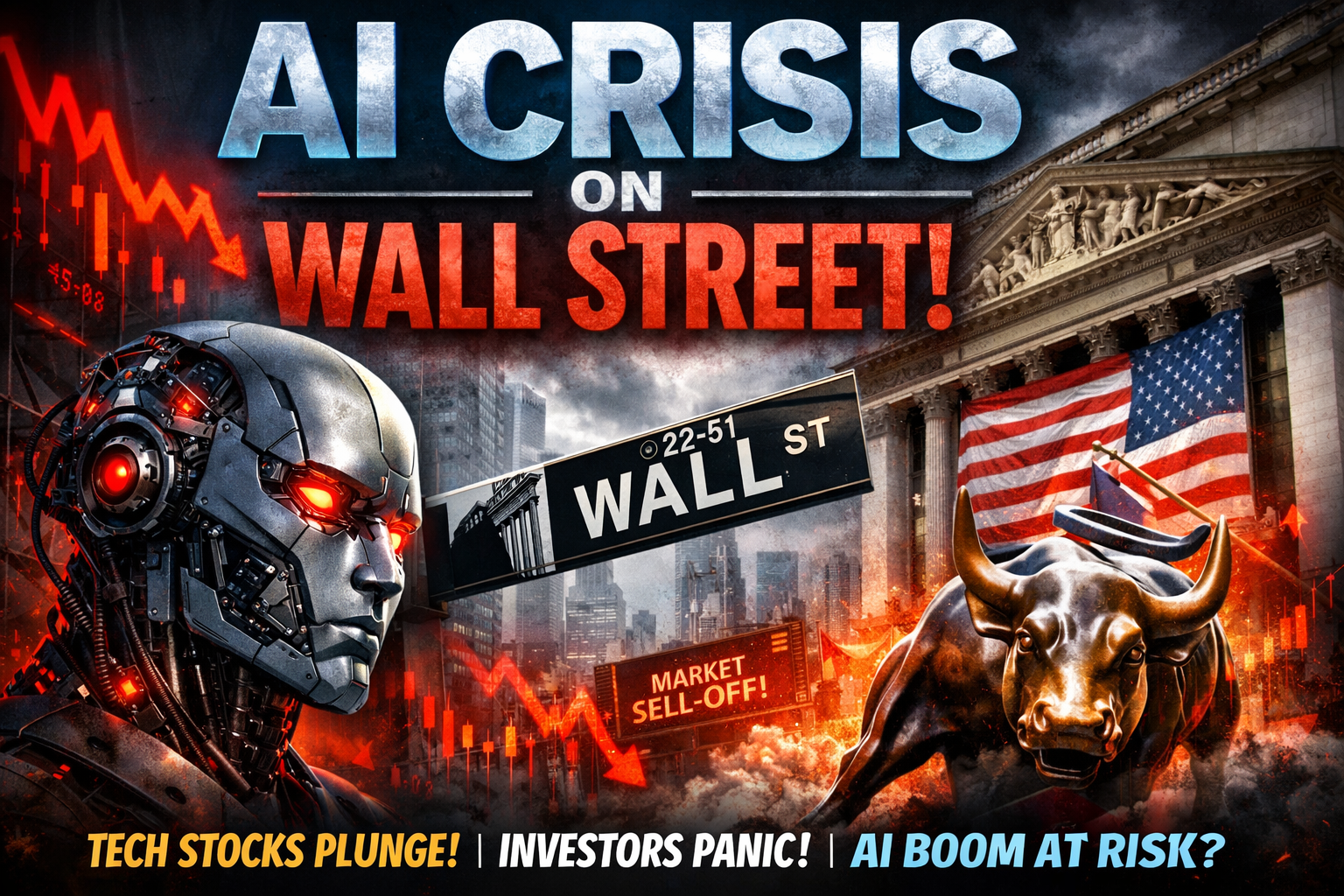
AI Turmoil on Wall Street: When Hype Meets Hard Truths
Why Artificial Intelligence Is Sinking Tech Stocks — and What That Means for the U.S. Economy, the Labor Market, and the Future of Innovation
Investors and Wall Street have long viewed artificial intelligence not just as a revolutionary technology, but as the economic engine of the next decade. From Silicon Valley startups to established tech giants, AI has been pitched as the driver of productivity growth, transformative innovation, and unprecedented profits. Yet as 2026 unfolds, a sharp shift in market sentiment has turned that narrative on its head — and the repercussions are reverberating across financial markets, corporate America, and Main Street alike.
Major Tech Stocks Plunge on Profitability Concerns
On February 16, 2026, financial markets in the United States saw a dramatic downturn in major technology stocks as investor confidence in AI-led growth faltered.
Shares of tech giants like Microsoft, Amazon, Apple, Alphabet, and Nvidia — once the darlings of the AI boom — suffered steep declines. Microsoft alone saw its valuation drop sharply as investors questioned whether massive AI spending would ever translate into sustainable profits.
In total, hundreds of billions of dollars in market value was erased, signaling a sobering reassessment of AI’s short-term economic impact.
The sell-off stemmed from mounting concerns that the high capital expenditures poured into AI infrastructure, model development, and data centers are not yet producing the meaningful bottom-line improvements that financial markets demand.
Market Rotation & Sector-Wide Worries
The broader market’s reaction wasn’t limited to headline tech players. Software stocks — previously buoyed by optimism over AI’s future profitability — have been under particular pressure. Recent sharp declines in U.S. software equities indicate that investor enthusiasm is waning, especially for companies whose traditional business models could be disrupted by AI advancements.
Industry analysts characterize the trend as an “AI scare trade,” where fear of disruption has spread quickly through equity markets, dragging down even non-tech sectors perceived as vulnerable to automation and algorithmic competition.
At the same time, some segments of the market have outperformed, with sectors like consumer staples, energy, and materials gaining ground as investors search for stability outside the tech landscape.
Is the AI Boom Running Out of Steam?
Wall Street’s dramatic reassessment raises the question: Has the AI boom peaked, at least temporarily? Analysts at major financial firms have warned that current valuations may no longer reflect the true economic returns of AI spending. Overly ambitious capital expenditure forecasts — in some cases exceeding hundreds of billions of dollars — have raised red flags over a potential “AI bubble.”
UBS recently downgraded the U.S. technology sector, citing uncertainty in software demand and the risk of an AI-infrastructure spending slowdown as key dangers holding back future growth.
While some investors remain hopeful that AI innovation will eventually pay dividends through enhanced productivity and new revenue streams, others are urging caution, emphasizing that not all AI investments yield commercial success.
The Real Economy: Jobs, Disruption, and Worker Anxiety
The market shake-up isn’t just a financial story — it reflects broader societal concerns about how AI is reshaping work, employment, and economic stability in the U.S.
A growing body of research shows that AI’s automation capabilities could affect a significant portion of the workforce in the coming years. Estimates from financial institutions like Goldman Sachs suggest that AI and automation could expose millions of jobs to potential displacement, especially tasks that are routine or data-driven.
Meanwhile, local business impacts are already emerging. Recent reports have highlighted AI-related layoffs in cities like Denver and Golden, Colorado, where companies cite automation as a reason for workforce cuts — triggering economic ripple effects in local communities.
While many experts argue that AI could also create new opportunities and jobs, the pace of change is accelerating, and most workers aren’t yet equipped with the skills required to thrive in an AI-enhanced economy. This mismatch raises concerns about income inequality, labor market polarization, and the need for large-scale workforce retraining.
Regulatory & Policy Dimensions
The shifts in AI investment and employment have also sparked fresh debate over government policy and regulation. California’s Transparency in Frontier Artificial Intelligence Act, for example, aims to hold AI companies accountable by requiring them to publish risk assessments and safety documentation.
At the federal level, efforts to recruit tech talent into government roles — such as the newly launched United States Tech Force initiative — demonstrate an increasing recognition that AI policy and oversight will be key to national competitiveness and security.
Yet comprehensive federal AI regulation remains in flux, and business leaders continue to push back against what they view as potentially burdensome oversight.
What Comes Next?
The current moment may represent a crucial inflection point in the evolution of artificial intelligence in the U.S. economy.
On the financial side, markets are recalibrating how much profit AI can realistically generate in the near term. On the labor side, workers and policymakers are confronting a future in which AI’s capabilities are increasingly central to economic productivity and job creation — but also potentially disruptive to traditional employment structures.
Smart investors, corporate leaders, and policymakers alike will need to balance the long-term potential of AI with short-term realities. In an era where technology evolves faster than regulation, and where optimism meets skepticism, the only certainty is that AI’s role in America’s economic future will remain a hot topic of debate and development in 2026 and beyond.
1Keywords
-
artificial intelligence news USA
-
AI stock market crash
-
Big Tech AI spending
-
Microsoft AI losses
-
Nvidia stock AI
-
AI bubble 2026
-
Wall Street tech selloff
-
AI market volatility
-
AI investment risks
-
U.S. tech sector downturn
-
AI job displacement
-
AI regulation United States
-
AI economic impact
-
Silicon Valley AI crisis
-
future of artificial intelligence




I really wanted to send a small word in order to thank you for some of the marvelous concepts you are posting at this website. My prolonged internet investigation has now been recognized with good quality content to exchange with my great friends. I ‘d assert that most of us readers actually are unquestionably fortunate to live in a useful network with very many lovely people with interesting strategies. I feel rather happy to have seen your website and look forward to tons of more awesome times reading here. Thank you again for everything.
Excellent blog here! Also your web site loads up fast! What web host are you using? Can I get your affiliate link to your host? I wish my website loaded up as fast as yours lol
Once I originally commented I clicked the -Notify me when new feedback are added- checkbox and now each time a remark is added I get 4 emails with the identical comment. Is there any means you’ll be able to take away me from that service? Thanks!