
Trump’s Week in Review: Indictments, Policy Shifts, and Global Tensions
Keywords: Trump news week review federal indictment SPLC controversy marijuana reclassification US policy changes ceasefire negotiations conservative news IRS investigation tax exempt status politics
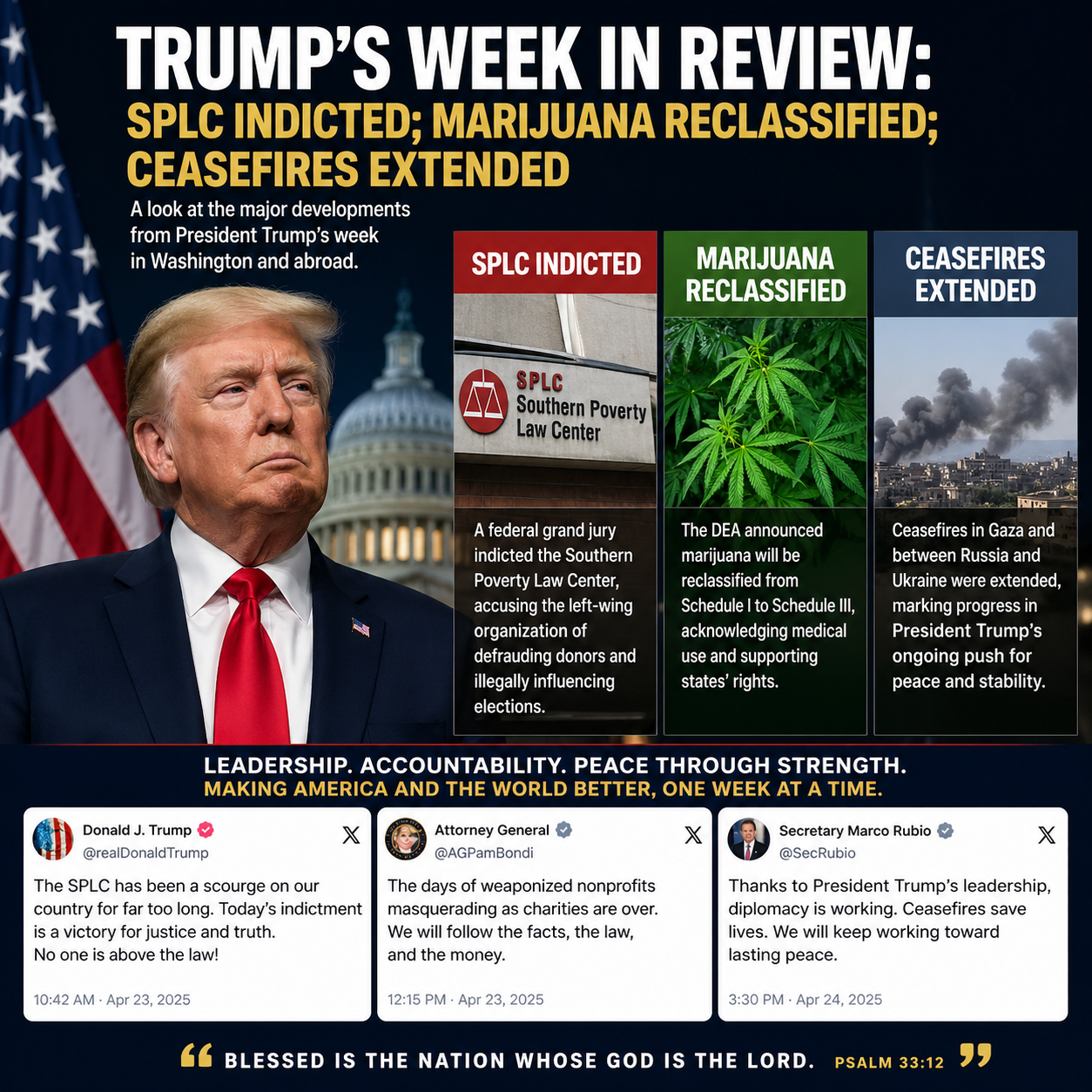
A series of consequential developments marked a politically charged week for Donald Trump, as legal, domestic policy, and foreign affairs issues converged to shape the national conversation. From a federal indictment involving the Southern Poverty Law Center (SPLC) to shifts in federal drug policy and ongoing ceasefire negotiations abroad, the week underscored the administration’s assertive posture across multiple fronts.
The most headline-grabbing event came with the reported federal indictment tied to the SPLC, an organization long influential in shaping narratives around extremism and hate groups. Critics of the SPLC, particularly within conservative and Christian circles, have argued for years that the organization operates with ideological bias while maintaining tax-exempt status. The indictment has intensified scrutiny over its operations and financial practices.
According to watchdog groups cited in recent reporting, calls have now escalated for the Internal Revenue Service to review whether the SPLC’s activities align with its nonprofit designation. The argument centers on whether political advocacy and selective targeting of conservative or faith-based organizations have crossed legal boundaries that govern tax-exempt entities.
Supporters of the investigation contend that accountability should apply evenly across the ideological spectrum. They argue that institutions wielding cultural influence must adhere to the same standards they often demand of others. For many within the conservative Christian community, the development represents a potential turning point in challenging what they view as institutional bias against traditional values.
At the same time, federal drug policy saw a notable shift with the reclassification of marijuana. The move reflects a broader trend toward normalization and regulatory restructuring at the federal level. While proponents frame the decision as a pragmatic adjustment acknowledging state-level legalization trends, critics raise concerns about the societal and moral implications of expanded drug acceptance.
From a conservative Christian perspective, the reclassification debate extends beyond policy mechanics into questions of public health, personal responsibility, and cultural direction. Some leaders have cautioned that loosening restrictions may inadvertently contribute to increased dependency and diminished societal discipline, particularly among younger populations.
Meanwhile, international developments added another layer of complexity to the week’s events. Ongoing ceasefire agreements in key global conflict zones were extended, signaling a temporary easing of tensions. Diplomatic channels appear to remain active, with U.S. leadership playing a role in maintaining fragile agreements.
Observers note that while ceasefires offer short-term relief, they often mask deeper unresolved conflicts. The administration’s approach has emphasized stability and negotiation, though skepticism remains regarding the durability of such arrangements. For many Americans, particularly those with a strong interest in global religious freedom, the protection of vulnerable communities in conflict zones remains a pressing concern.
Social media platforms, particularly X, reflected a surge in public engagement surrounding these developments. One widely shared post read: “Accountability is coming for institutions that have operated unchecked for too long.” Another user commented, “Policy shifts like marijuana reclassification show how fast culture is changing—and not always for the better.” These sentiments highlight the broader cultural divide shaping public interpretation of the week’s events.
Video commentary circulating online further amplified these discussions. Several political analysts emphasized the significance of the SPLC indictment as part of a larger trend toward institutional scrutiny. Others focused on the geopolitical implications of extended ceasefires, warning that temporary agreements should not be mistaken for lasting peace.
Within conservative Christian circles, the week’s developments have been framed through a lens of moral clarity and institutional accountability. Commentators have pointed to biblical principles emphasizing justice, truth, and the proper role of governing authorities. The unfolding events are seen not merely as political milestones but as indicators of deeper cultural and spiritual currents.
The convergence of legal action, policy reform, and international diplomacy illustrates the multifaceted nature of governance in the current era. Each development carries implications that extend beyond immediate headlines, shaping the broader trajectory of the nation and its role on the global stage.
For supporters of the administration, the week represents decisive action and a willingness to confront entrenched systems. For critics, it raises questions about long-term consequences and the balance of power. The debates are likely to continue as further details emerge and policies take shape.
As the news cycle moves forward, the events of this week will remain a focal point for analysis and discussion. Whether viewed through a political, cultural, or spiritual lens, they underscore the ongoing tension between competing visions for the future of the country.
The coming weeks will reveal whether these developments mark the beginning of sustained change or simply another chapter in an already turbulent political landscape.


yahoo,im go
Wish you happiness
Thank you for sharing excellent informations. Your site is so cool. I am impressed by the details that you have on this blog. It reveals how nicely you understand this subject. Bookmarked this website page, will come back for extra articles. You, my pal, ROCK! I found just the information I already searched everywhere and just could not come across. What a perfect site.
Hahahaha You are so good
75t95x
azaibu
Good a blog toper
Im 4466,yahoo
Here you are