

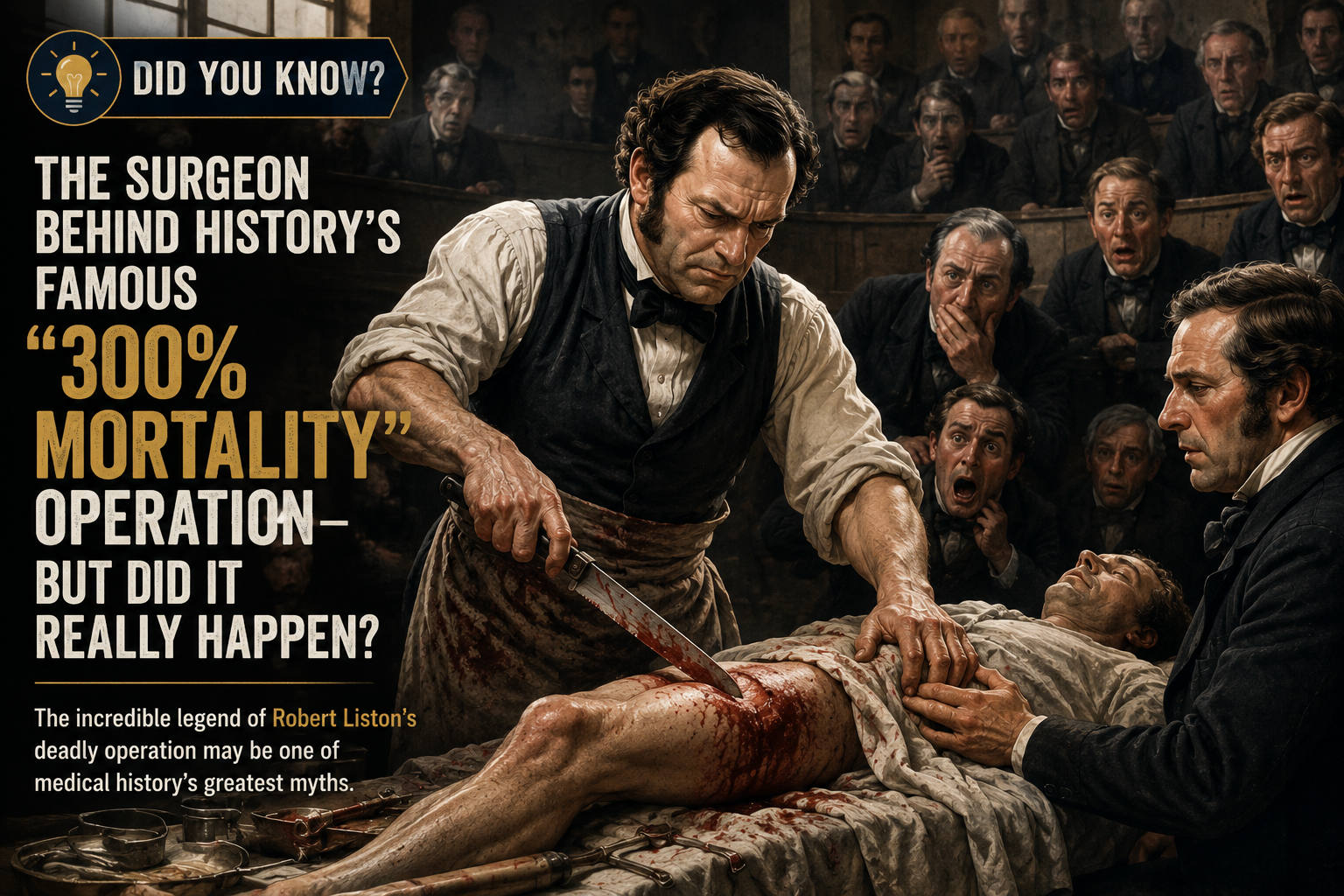
Imagine walking into an operating room knowing there would be no modern anesthesia, no antibiotics and no guarantee that the surgeon had any understanding of germs.
Now imagine that the man standing over you with the surgical knife was famous for one particular skill:
Speed.
His name was Robert Liston.
He became one of the most famous surgeons of the 19th century, legendary for amputating limbs with astonishing speed during an era when every additional second on the operating table meant additional agony for the patient.
But Liston eventually became famous for something else.
A story has been repeated for decades claiming that one of his operations resulted in the only known surgery with a 300% mortality rate.
The patient died.
His assistant supposedly died.
And a spectator reportedly died too.
Three deaths.
One patient.
One operation.
There’s just one problem.
The famous story probably never happened.
Surgery Before Anesthesia
To understand Robert Liston, you have to understand the terrifying world of surgery in the early 1800s.
Modern patients are usually unconscious during major surgery.
Liston’s patients weren’t.
Before reliable surgical anesthesia became available, patients undergoing amputations could be fully conscious while surgeons cut through skin and muscle and then sawed through bone.
The faster the surgeon worked, the shorter the patient’s suffering.
Speed wasn’t simply theatrical.
Speed was considered a surgical skill.
And Robert Liston was extraordinarily fast.
Born in Scotland in 1794, Liston developed a reputation as one of Britain’s most formidable surgeons.
Historical accounts describe him as physically imposing, technically gifted and capable of performing amputations in remarkably short periods of time.
At least one documented recollection describes an amputation completed in less than 30 seconds.
Imagine watching that operation.
A patient is restrained.
The surgeon takes his knife.
Seconds later, the limb is gone.
It sounds barbaric today.
But in the world before anesthesia, those seconds mattered.
The Most Infamous Operation in Medical History
Now we come to the story that transformed Liston from famous surgeon into medical legend.
According to the version repeated in popular histories, Liston was performing a leg amputation when his legendary speed went disastrously wrong.
As he swept his knife through the patient’s leg, Liston supposedly cut the fingers of the assistant helping hold the patient.
Then the knife allegedly slashed the clothing of a spectator standing nearby.
The patient later died from infection.
The assistant supposedly developed an infection and died as well.
And the terrified spectator reportedly believed he had been stabbed and collapsed from fright.
Three deaths associated with one operation.
Thus the famous punchline:
One operation. One patient. A 300% mortality rate.
It’s an unforgettable story.
There’s a reason you’ve probably encountered some version of it online.
But unforgettable doesn’t necessarily mean true.
Did It Actually Happen?
This is where the story becomes even more interesting.
Modern historical research has examined the origins of the 300% mortality story, and the evidence supporting it is remarkably weak.
Historian Michael Brown, writing about British surgical history for Cambridge University Press, examined how Liston’s reputation evolved after his death.
His conclusion is striking.
The famous 300% mortality story appears to be a mixture of exaggeration, later anecdotes and outright fiction.
There is apparently no contemporary evidence establishing that a spectator died of fright during one of Liston’s operations.
Even the story that Liston accidentally severed his assistant’s fingers appears to emerge much later rather than from records created during Liston’s lifetime.
In other words, one of the most famous stories in the history of medicine may be an excellent example of how legends are created.
How Does a Legend Become “History”?
This is one of the reasons stories like this fascinate me.
History doesn’t always become distorted because somebody intentionally lies.
Sometimes a good story simply gets repeated.
One author tells it.
Another author quotes the first author.
A television documentary repeats it.
A website summarizes the documentary.
Someone posts the story on social media.
Eventually thousands of people repeat it.
And after enough repetition, nobody remembers to ask the most important question:
Where did the story originally come from?
That’s apparently what happened to Robert Liston.
A particularly influential version appeared in Richard Gordon’s 1983 book Great Medical Disasters.
Later books and popular histories repeated versions of the tale.
Eventually the “300% mortality operation” became one of the most famous anecdotes in surgical history.
But historians tracing the story backward found that some of its most dramatic details simply don’t have solid contemporary documentation.
The Real Robert Liston May Be More Interesting
The irony is that turning Liston into a reckless caricature may obscure what was genuinely remarkable about him.
His speed was real.
But speed wasn’t necessarily about showing off.
Liston understood something painfully obvious to anyone watching surgery before anesthesia:
The longer the operation lasted, the longer the patient suffered.
In an 1844 lecture, Liston instructed surgical students that operations should be performed as quickly as possible in order to minimize the patient’s pain.
That changes the picture considerably.
The legendary Liston looks like a reckless surgeon racing against a stopwatch.
The historical Liston appears to have understood that speed could be an act of mercy in an age when surgery meant unimaginable pain.
Then Medicine Changed Almost Overnight
Near the end of Liston’s career, something extraordinary happened.
Doctors discovered that patients could be rendered unconscious during surgery using ether.
Think about what that meant.
For generations, surgery and extreme pain had been inseparable.
Suddenly they didn’t have to be.
And Liston didn’t resist the new technology.
He embraced it.
On December 21, 1846, at University College Hospital in London, Liston performed a thigh amputation while the patient was under ether anesthesia.
It became a landmark moment in British surgical history.
The man famous for operating at extraordinary speed had lived long enough to see the beginning of a world in which surgeons no longer needed to race against their patients’ pain.
But Anesthesia Didn’t Solve Everything
There was still another enormous problem.
Infection.
The germ theory of disease had not yet transformed everyday surgical practice.
Operating rooms were nothing like today’s sterile environments.
Surgeons could move between patients without the infection-control procedures we now take for granted.
Operations could be technically successful only for patients to die later from postoperative infection.
The great revolution in antiseptic surgery associated with Joseph Lister would come later.
Robert Liston stood at a fascinating moment between two worlds.
He learned surgery in an era dominated by speed and pain.
He died just as anesthesia was beginning to change medicine forever.
The Story That Wasn’t True Still Teaches Us Something
So did Robert Liston really perform history’s only operation with a 300% mortality rate?
Almost certainly not.
But perhaps the truth is more interesting than the legend.
Liston’s story gives us a glimpse into a world where surgery looked almost unimaginable by modern standards.
It reminds us how rapidly medicine can change.
And it demonstrates something else worth remembering in our own age of viral stories and social media:
A story repeated thousands of times doesn’t automatically become true.
Sometimes the most interesting question isn’t:
“Did you know?”
Sometimes it’s:
“How do we know?”
Did You Know?
History is filled with incredible stories — and sometimes the story behind the story is even better.
For more forgotten history, extraordinary people and stories you probably never learned in school, visit Did You Know?.
LIVE CURIOUS. STAY INFORMED. FINISH WELL.