
Prefer to listen? Press play above. Prefer to read? The full article continues below.
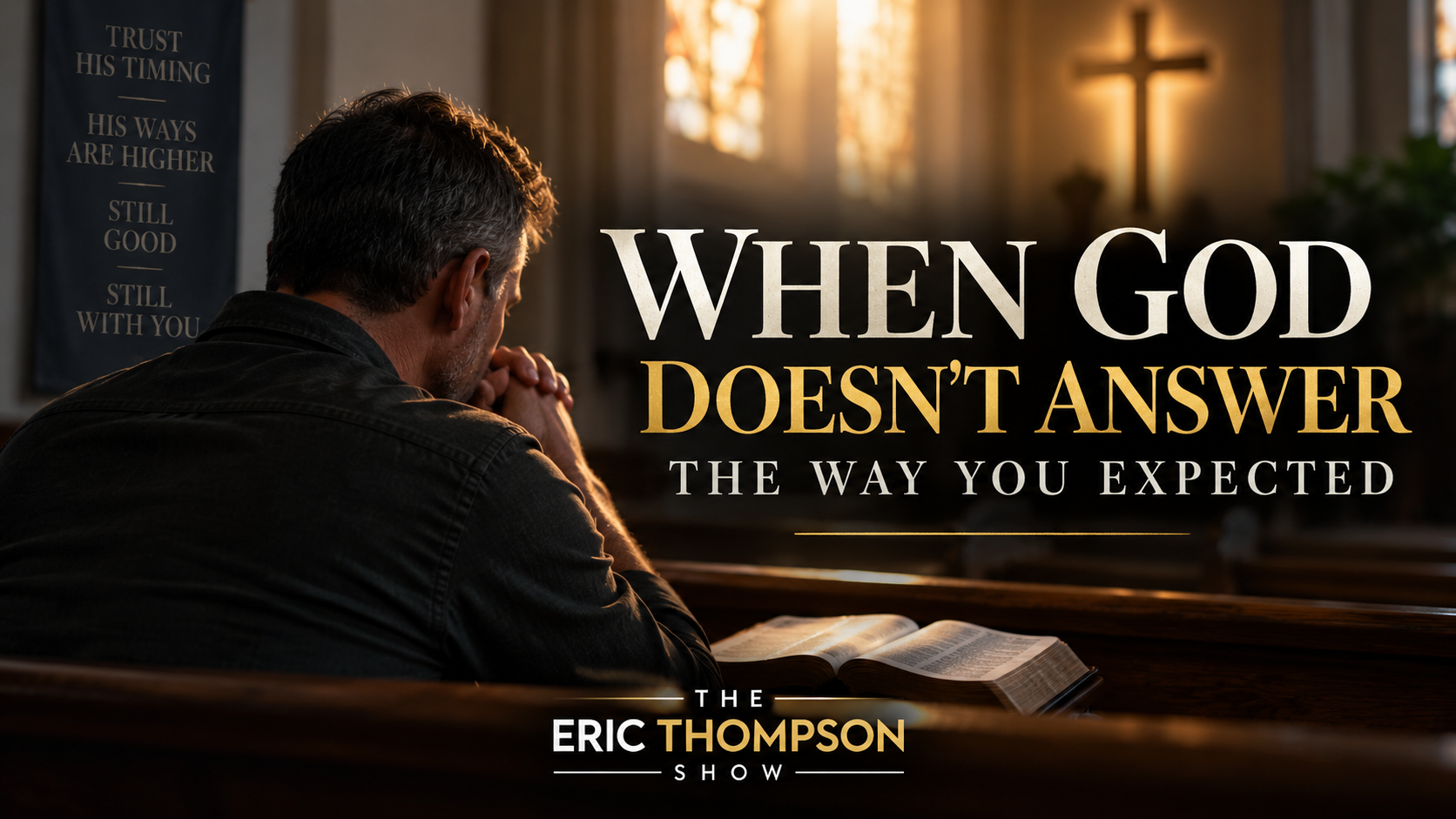
There are few things more difficult in the Christian life than praying faithfully for something good—and watching God answer differently than you expected.
Maybe you prayed for a marriage to be restored.
Maybe you prayed for a child who had wandered away.
Maybe it was a job, a diagnosis, a financial crisis, a broken relationship, or someone you loved who was suffering.
You prayed. Other people prayed with you. You tried to trust God.
And then the answer you wanted never came.
For Christians, that can create questions we’re sometimes reluctant to say out loud.
Did God hear me?
Did I pray the wrong way?
Was my faith not strong enough?
Or perhaps the hardest question:
If God loves me, why didn’t He change this?
Those aren’t necessarily questions of unbelief. Sometimes they’re the questions of someone desperately trying to believe while walking through something he or she doesn’t understand.
And Scripture doesn’t pretend those moments don’t exist.
The Bible Never Promises an Easy Life
One of the great distortions of modern Christianity is the idea that following Christ should produce a relatively comfortable life.
Be faithful enough. Pray enough. Believe enough.
And somehow everything is supposed to work out.
That’s not the Christianity we encounter in Scripture.
The Apostle Paul pleaded with God three times to remove what he called his “thorn in the flesh.”
God didn’t remove it.
Instead, the Lord told Paul:
“My grace is sufficient for you, for power is perfected in weakness.”
— 2 Corinthians 12:9
Paul didn’t receive the answer he requested.
He received something else.
Grace sufficient to endure the answer God gave him.
That’s a much harder message than “believe and everything will work out.”
But it’s also a much stronger one.
Christian hope doesn’t require us to pretend suffering isn’t real.
It tells us that suffering doesn’t get the final word.
Jesus Himself Prayed a Prayer That Teaches Us Something
Think about Christ in Gethsemane.
Knowing what awaited Him, Jesus prayed:
“My Father, if it is possible, let this cup pass from Me; yet not as I will, but as You will.”
— Matthew 26:39
There is something enormously important in that prayer.
Jesus expressed His desire.
He didn’t pretend the suffering ahead was pleasant. He didn’t treat pain as insignificant.
But He submitted His desire to the Father’s will.
“Not as I will, but as You will.”
That’s not weakness.
That’s extraordinary trust.
And sometimes the deepest expression of Christian faith isn’t believing God will give us what we’re asking for.
It’s believing God is still God when He doesn’t.
Prayer Isn’t a Transaction
It’s easy—even for mature Christians—to begin treating prayer almost like a spiritual transaction.
I pray.
I believe.
I obey.
Therefore God should do this.
But God isn’t a vending machine, and prayer isn’t the currency we put into it.
Prayer is relationship.
We bring our petitions before a sovereign Father who sees things we cannot see, knows things we cannot know, and understands consequences extending far beyond our immediate circumstances.
Isaiah records God’s words:
“For My thoughts are not your thoughts,
Nor are your ways My ways,” declares Yahweh.— Isaiah 55:8
That verse isn’t an excuse to stop thinking.
It’s a reminder of perspective.
We’re looking at one piece of the story.
God sees the whole thing.
Sometimes We Understand Later
I’ve lived long enough to recognize something I couldn’t always recognize when I was younger:
Some of the things I desperately wanted would not have been good for me.
There are doors I wanted opened that I’m now grateful stayed closed.
There were situations I couldn’t understand at the time that look very different years later.
Maybe you’ve experienced that too.
But we also need to acknowledge something Christians sometimes gloss over:
There are other things we may never understand in this life.
Some losses don’t eventually reveal a neat explanation.
Some relationships aren’t restored.
Some diseases don’t disappear.
Some children don’t come home.
Some tragedies never make sense from our side of eternity.
Christian faith doesn’t require us to manufacture an explanation where God hasn’t given us one.
Instead, we’re called to trust the character of the One who sees what we cannot.
Faith Isn’t Denying Reality
Biblical faith isn’t positive thinking.
It isn’t pretending everything is fine when everything clearly isn’t fine.
Read the Psalms.
David cries out:
“How long, O Yahweh? Will You forget me forever?”
— Psalm 13:1
That’s in the Bible.
God preserved those words for us.
There is grief in Scripture.
There is confusion.
There is anger.
There is lament.
There are faithful people asking God why.
The difference is that biblical lament keeps turning toward God rather than permanently away from Him.
David begins Psalm 13 asking how long God will forget him.
But by the end he says:
“But I have trusted in Your lovingkindness;
My heart shall rejoice in Your salvation.”— Psalm 13:5
His circumstances hadn’t necessarily changed between verse one and verse five.
His focus had.
When God Seems Silent
Silence can be one of the hardest answers to prayer.
We want direction.
We want clarity.
We want God to tell us exactly what He’s doing.
And sometimes He doesn’t.
That’s when we have to distinguish between what we feel and what we know.
I may feel abandoned.
Scripture tells me Christ will never leave His people.
I may feel hopeless.
Scripture tells me my ultimate hope isn’t dependent upon today’s circumstances.
I may feel that everything is falling apart.
Scripture reminds me that God’s sovereignty hasn’t somehow been suspended because my life became difficult.
Our emotions are real.
But they aren’t always reliable interpreters of reality.
God’s Word is.
That’s why difficult seasons aren’t the time to move away from Scripture.
They’re when we need Scripture most.
God’s Purpose Isn’t Simply Our Comfort
This is another truth that runs against much of modern culture.
Our culture tells us that happiness, comfort, personal fulfillment and self-expression are among life’s highest goals.
Scripture gives us something bigger.
God is forming His people into the likeness of Christ.
Romans 8:28 is frequently quoted:
“And we know that for those who love God all things work together for good…”
But we sometimes stop before Paul’s next thought.
Verse 29 tells us part of what that “good” looks like:
“…to become conformed to the image of His Son.”
God’s definition of good may be considerably larger than ours.
We often want God to change our circumstances.
Sometimes God is using our circumstances to change us.
To make us more patient.
More compassionate.
Less proud.
Less dependent upon ourselves.
More willing to serve.
More aware of how desperately we need Him.
That doesn’t make suffering pleasant.
But it means suffering doesn’t have to be pointless.
What Do You Do While You’re Waiting?
Maybe you’re reading this while you’re still waiting for an answer.
I don’t have a formula that will make your circumstances disappear.
Nobody does.
But Scripture gives us somewhere to stand.
Keep praying.
Not because persistence forces God’s hand, but because Christ taught His people to pray.
Stay in Scripture.
Especially when your feelings tell you otherwise.
Stay connected to other believers.
Isolation makes suffering heavier.
Serve somebody.
This one has become increasingly important to me.
When life turns inward, our problems can begin consuming our entire field of vision.
Sometimes one of the healthiest things we can do is look around and ask:
Who needs me today?
Someone needs encouragement.
Someone is lonely.
Someone needs a meal.
Someone needs a phone call.
Someone needs forgiveness.
Someone simply needs another human being willing to listen.
Serving someone else doesn’t erase our problems.
But it reminds us that God can still use us while we’re walking through them.
You Don’t Need to Understand Everything to Trust God
That’s ultimately where faith takes us.
Not to complete understanding.
To trust.
Proverbs tells us:
“Trust in Yahweh with all your heart
And do not lean on your own understanding.
In all your ways acknowledge Him,
And He will make your paths straight.”— Proverbs 3:5–6
Notice what Scripture doesn’t say.
It doesn’t say we’ll understand every path.
It says we can trust the One leading us down it.
I’m still learning that.
After decades of life, marriage, raising a family, becoming a grandfather, building businesses, experiencing successes, making mistakes and watching the world change around me, I’ve learned that some questions get answered.
Others don’t.
But my confidence in God cannot ultimately depend upon whether He follows the script I wrote for my life.
It has to rest in who He is.
And for the Christian, our greatest evidence of God’s character is found at the cross.
Christ didn’t promise His followers a life without suffering.
He gave us something infinitely greater.
He gave us Himself.
And because Christ died and rose again, the Christian’s story never ultimately ends with disappointment, suffering, sickness or death.
It ends with resurrection.
That doesn’t make today’s pain imaginary.
It puts today’s pain inside a much larger story.
So keep praying.
Keep trusting.
Keep serving.
Keep walking.
Even when the answer isn’t the one you expected.
Because sometimes faith isn’t seeing what God is doing.
Sometimes faith is trusting Him when you can’t.
Stay Connected
If articles like this help you think more deeply about faith, family, culture and the changing world around us, I’d like to invite you to join me.
The Eric Thompson Show is about more than politics or today’s headlines. We’re exploring the ideas, stories and conversations that affect the way we live—and how we can live with purpose in a rapidly changing world.
Join the Eric Thompson Show newsletter below.

Author: Eric Thompson
Eric Thompson hosts The Eric Thompson Show from Broken Arrow, Oklahoma, exploring faith, family, culture, AI and business through a Christian worldview.
Get the next conversation in your inbox
New Eric Thompson Show episodes, selected stories and Eric's perspective on AI, culture, faith, family and business.
Join the free ETT newsletterFree to join. Unsubscribe anytime.