
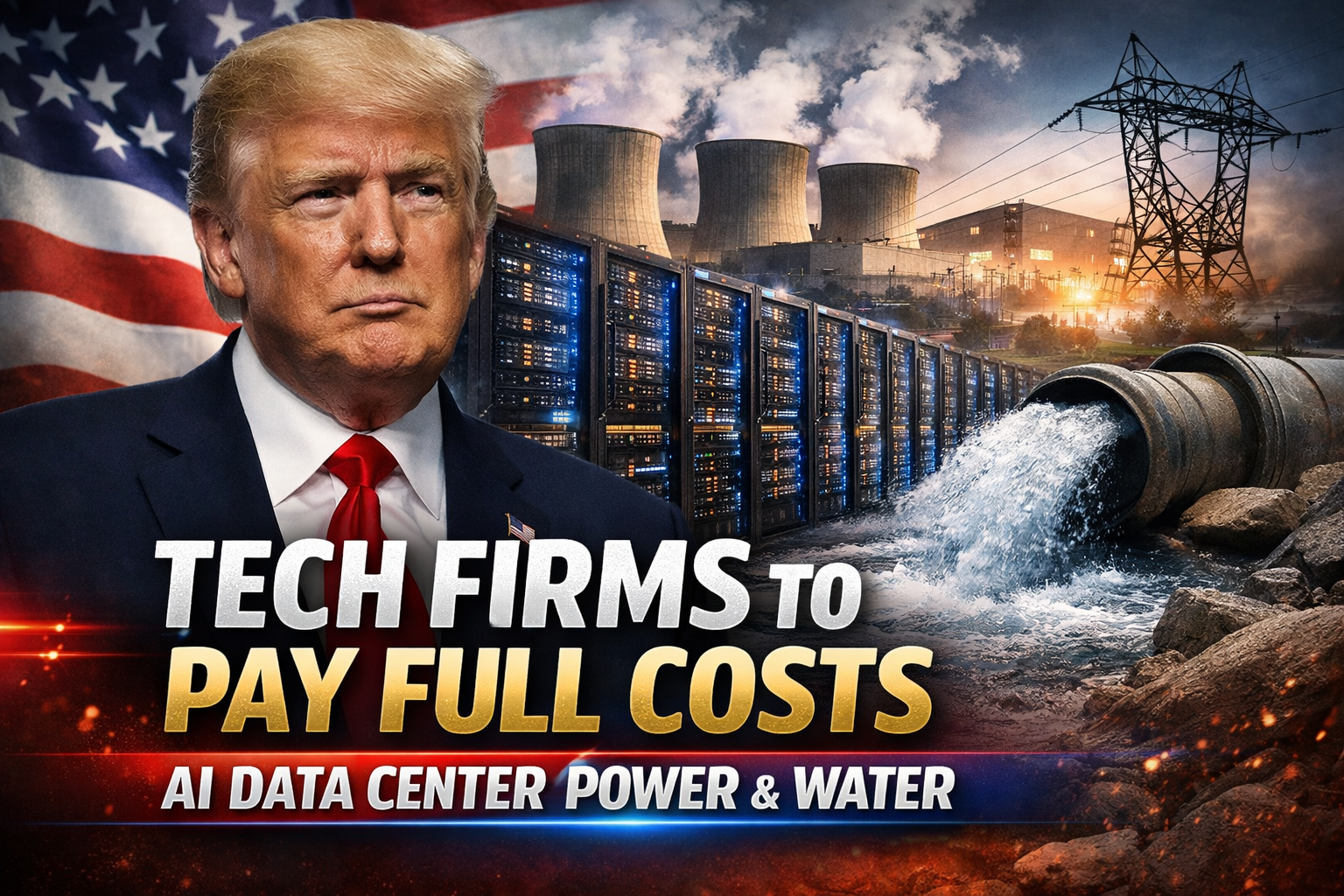
📊 Trump Administration Seeks Tech Firms to Cover Full AI Data Center Power, Water Costs
WASHINGTON, D.C. — The Biden-era debate over the rapid expansion of artificial intelligence infrastructure has shifted markedly under the Donald Trump administration, as federal policymakers are now advancing a plan to require major technology companies to assume full costs associated with the energy and water usage of their AI data centers.
The administration’s emerging strategy, outlined in recent public statements by trade adviser Peter Navarro and in draft agreements circulating among Washington insiders, signals a decisive policy aimed at protecting American households from bearing the financial burden of hyperscale data center growth.
Navarro, speaking on Fox News’ Sunday Morning Futures, articulated the administration’s position that Silicon Valley giants must “internalize” the expenses their operations impose on electric grids and water infrastructure, rather than passing those costs through to consumers or local utilities.
“All of these data center builders … need to pay for all of the costs — electricity, grid resiliency, water,” Navarro said, noting that taxpayers and American ratepayers should not shoulder the impact of the technology boom.
A Voluntary Compact With Teeth
According to reports, the White House is negotiating what it calls a voluntary energy and infrastructure compact with major tech companies. Under the draft compact, firms would commit to ensuring their AI data centers do not raise household electricity prices, strain water supplies, or undercut grid reliability. They would also commit to covering the costs of new infrastructure required to support their expansion.
While described by some officials as “voluntary,” the compact reflects intense pressure from the administration, which is intent on giving American consumers relief amid broader concerns about cost of living and utility affordability. The pact remains subject to revision before any formal White House announcement.
Industry Responses: Microsoft and Anthropic Move First
Some technology companies have already signaled willingness to align with this direction. Microsoft, for example, announced a “community first” initiative earlier this year aimed at paying full power costs for its AI data center footprint and rejecting local tax incentives that could shift expenses to taxpayers.
Similarly, artificial intelligence developer Anthropic recently pledged to fully fund grid upgrades tied to its AI facilities, rather than passing the associated costs to ratepayers — a move the company frames as responsible corporate citizenship.
This positioning distinguishes the Trump administration’s view from prior policies that many critics say encouraged tech infrastructure without sufficient consideration of economic impact on ordinary families.
Grid Strain and Rising Utility Bills
The expansion of data centers — facilities that house vast arrays of servers to train and operate AI models — has triggered concerns across multiple states as local energy grids strain to keep pace with demand. Former utility filings show that electric and gas companies have sought billions in rate increases, frequently citing the added load from hyperscale data center operations.
Economists warn that without significant investment in generation and transmission capacity, regions with heavy data center activity could face more frequent grid congestion and higher prices for all customers.
A recent Reuters analysis also noted that regulators are beginning to explore long-term contracts and infrastructure charges to ensure that costs aren’t simply absorbed by other ratepayers.
Water Usage Concerns
Aside from power, water consumption has emerged as another point of scrutiny. AI data centers use significant quantities of water for cooling systems, especially during summer months and in regions already facing scarcity. While precise federal data on water draw isn’t yet public, industry models show that data center cooling can be a major addition to local water demand.
Administration officials argue that requiring tech companies to account fully for these impacts — including reclamation, recycling, and local return of water resources — will help prevent unintended consequences for community utilities.
Political Stakes and Consumer Impact
The push to make tech companies pay their own way has political dimensions. Inflationary pressures and rising utility costs rank high among voter concerns ahead of the upcoming midterm elections — an environment in which Republican leaders are eager to demonstrate responsiveness to kitchen-table economics.
Critics of the trend toward government demands on private industry assert that market forces could naturally address these problems, with increased demand prompting investment in power generation and efficiency improvements without heavy political interference. However, the administration maintains that proactive guidance is needed, lest utility costs continue to climb for average Americans.
Future Outlook
As the draft compact moves toward finalization, White House officials have hinted at forthcoming announcements with participating firms. Whether this initiative will shape larger regulatory moves or remain largely voluntary remains to be seen. What’s clear is that the Trump administration has placed the economics of AI infrastructure at the forefront of federal policy — prioritizing protections for consumers as digital growth accelerates.
📰 Clickbait Titles
-
Tech Must Pay AI Power Bills Now
-
Trump Forces Silicon Valley to Foot Bill
-
Big Tech Faces Cost Backlash for AI
🔑 High-Value Keywords
-
AI data centers
-
energy costs
-
utility bills
-
Trump administration
-
Peter Navarro
-
tech infrastructure
-
grid upgrades
-
power pricing
-
water usage
-
hyperscale facilities
-
consumer protection