
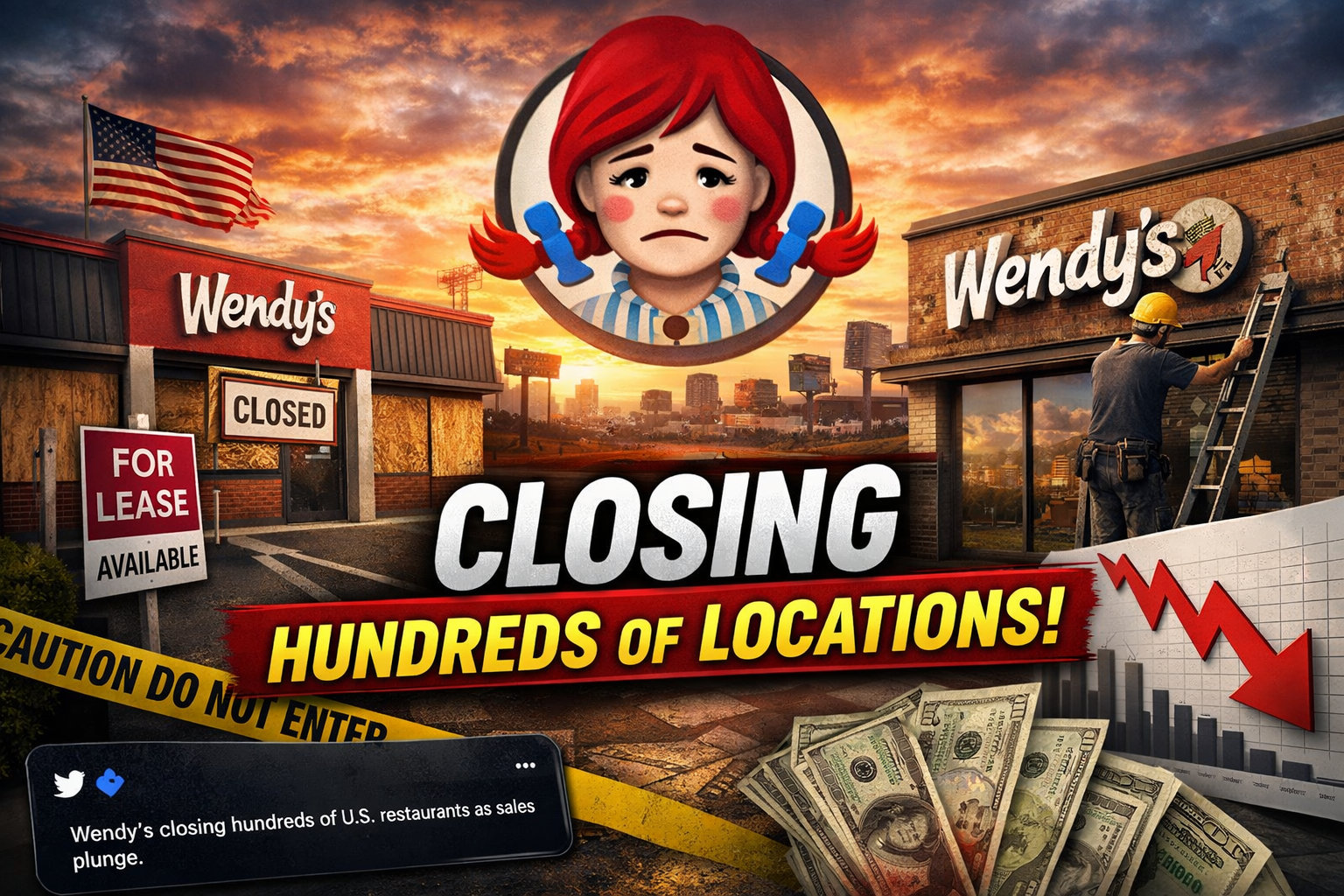
Wendy’s Announces Mass U.S. Restaurant Closures Amid Sales Decline
Dublin, Ohio — The Wendy’s Company, one of America’s largest quick-service restaurant brands, is moving forward with plans to close hundreds of U.S. locations this year as it attempts to halt a prolonged slide in domestic sales and reconnect with cost-conscious consumers.
In the fourth quarter of 2025, the chain reported a steep decline in U.S. same-store sales — down more than 11% compared with the prior year — an underperformance that company executives say requires strategic course corrections.
Interim CEO Ken Cook told investors that Wendy’s has shuttered 28 restaurants during the last quarter of 2025 and expects to close an additional 5% to 6% of its approximately 5,969 U.S. restaurants, equal to roughly 298 to 358 locations, in the first half of 2026.
The closures are part of what the company calls Project Fresh, a broader operational overhaul intended to “revitalize the brand, reignite growth and accelerate profitability.”
Industry data show that Wendy’s is not alone in confronting changing consumer habits. Many quick-service restaurants are contending with inflationary pressures on input costs and wage expense increases that have squeezed margins and compelled some brands to retool their offerings to emphasize value. Yet rivals such as McDonald’s have managed to see growth by leaning into everyday value propositions more aggressively.
Market Conditions and Value Focus
Cook acknowledged that Wendy’s had “swung the pendulum too far towards limited-time price promotions instead of everyday value,” a misstep the company says it is correcting with new pricing strategies.
In January, the chain introduced a permanent value menu called “Biggie Deals,” featuring $4, $6 and $8 price tiers — a direct appeal to budget-minded customers who have reduced dining out in favor of essential goods.
Wendy’s sales woes reflect broader consumer trends. According to financial reports, revenue fell 5.5% in the October–December period to $543 million, slightly exceeding analysts’ modest expectations but still indicating weakening demand.
Still, the company projects that global systemwide sales, which include both U.S. and international markets, will be flat in 2026 following a 3.5% decline in 2025.
Impact on Franchisees and Locations
The planned closures will disproportionately affect underperforming restaurants that have struggled to attract sufficient customer traffic in recent years. In conversations with franchise partners, the company says it identified weaker venues where investment returns were eroding.
Some franchise operators have reportedly been given options to renovate or sell sites, though many locations will simply be shuttered as part of the system optimization.
While Wendy’s still operates roughly 6,000 U.S. restaurants, the contraction of as many as 358 locations marks a significant retrenchment for a chain that once earned strong brand loyalty for products like the Dave’s Single and the Frosty.
Consumer and Investor Reaction
Initial investor response to the closures and the shift toward value has been cautiously positive, with Wendy’s stock climbing nearly 5% in midday trading following closure announcements.
However, the market remains wary. Shares have traded near multi-year lows as investors weigh the effectiveness of the company’s turnaround plan against persistent industry headwinds.
Customers have also voiced frustration over perceived value erosion, noting that combo meals today carry prices similar to sit-down dining without commensurate quality improvements. Independent commentators on platforms like “97.3 The Dawg” cite inflation fatigue and reduced disposable income as drivers of the downturn.
Analyst Perspectives
Industry analysts underscore that repositioning around value menus and streamlining operations is a typical response when a mature brand confronts sales contraction and market share challenges. But they note execution risks, particularly in maintaining consistent quality while competing with rivals that have built recent momentum.
Conservative business observers argue that adapting to consumer demand — especially by offering affordable options — is a necessary corrective rather than a sign of fatal decline, especially given broader economic pressures on households. They also caution against excessive reliance on ephemeral promotions that can undermine brand equity over time.
Looking Ahead
As Wendy’s embarks on what Cook described as a “rebuilding year,” the company’s ability to balance value with profitability will remain under scrutiny from both customers and investors.
While the closures signify a contraction in the U.S. footprint, the chain hopes that a leaner, more value-oriented operation can restore traffic and strengthen long-term competitiveness.