

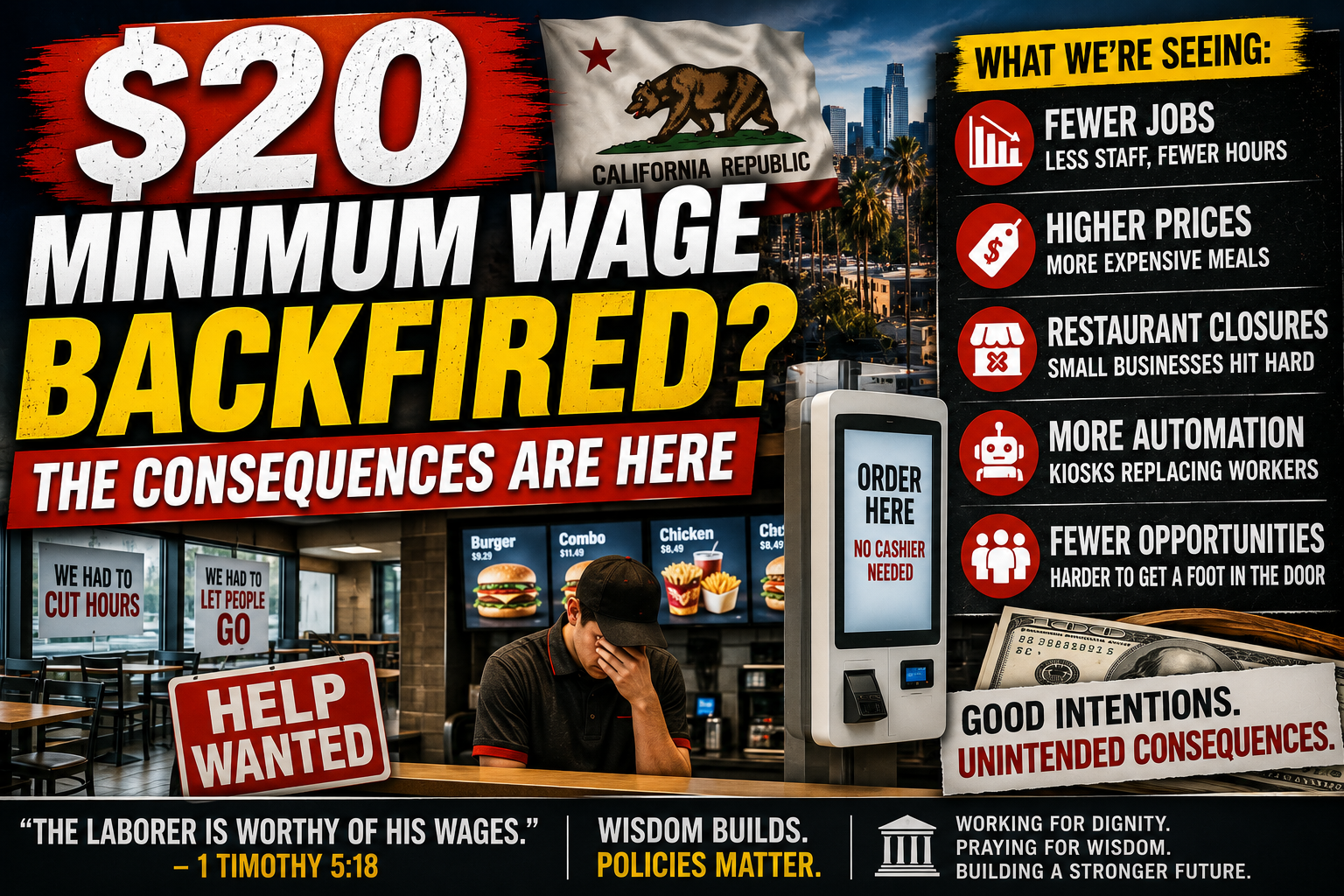
A $20 Minimum Wage Sounded Like a Win—Until These Consequences Began to Surface
When California raised the minimum wage for most fast-food workers to $20 an hour in April 2024, supporters hailed the move as a historic victory for working families. They argued that higher wages would help employees keep pace with inflation and the rising cost of living.
More than a year later, however, economists, business owners, and workers are debating whether the policy has produced unintended consequences.
Supporters point to thousands of employees who are earning larger paychecks. Critics argue those higher wages have been offset by fewer jobs, reduced work hours, higher menu prices, and an accelerated push toward automation.
The debate has become one of the nation’s most closely watched economic experiments.
According to multiple economic analyses, California’s fast-food industry has experienced significant changes since the law took effect. Several restaurant operators have reduced staffing levels, delayed expansion plans, or closed locations altogether. Other businesses have invested in self-service kiosks, automated ordering systems, and labor-saving technology to offset higher payroll costs.
Some national restaurant chains have also increased menu prices, passing a portion of the additional labor costs on to consumers. For many families already struggling with inflation, a simple fast-food meal now costs noticeably more than it did just a few years ago.
Not every business has responded the same way.
Some restaurant owners report they have absorbed much of the increased labor expense through efficiency improvements and higher sales. Others say the wage increase has improved employee retention and reduced turnover, lowering hiring and training costs.
Still, many small franchise owners argue the new law has placed enormous pressure on already thin profit margins.
Economists remain divided over the long-term effects.
Some labor advocates believe higher wages stimulate local economies because workers have more money to spend.
Others argue that when government mandates wages beyond what businesses can sustainably afford, employers inevitably reduce hiring, cut employee hours, raise prices, or automate jobs.
California’s experience is now being closely watched by lawmakers across the country as several other states consider similar proposals.
For Christians, economic policy is not simply about dollars and cents.
It is about human flourishing.
Scripture teaches that honest work is good, employees deserve fair compensation, and employers should conduct business with integrity.
The Apostle Paul wrote:
“The laborer is worthy of his wages.” (1 Timothy 5:18)
Likewise, James 5 warns employers against exploiting workers by withholding fair pay.
At the same time, Scripture also affirms the importance of wisdom, stewardship, and honest commerce.
Proverbs 24:3 reminds us:
“By wisdom a house is built, and by understanding it is established.”
Policies that unintentionally eliminate entry-level jobs or make it more difficult for young people to enter the workforce deserve careful evaluation.
Many economists note that minimum-wage jobs have traditionally served as stepping stones. They provide teenagers, students, immigrants, and workers with limited experience an opportunity to gain valuable skills before advancing into higher-paying careers.
If those opportunities disappear because employers cannot afford additional workers, the people lawmakers intended to help may instead find fewer doors open.
John MacArthur has often observed that Scripture encourages both compassion and personal responsibility. Christians should care deeply about workers receiving fair treatment while also recognizing that businesses must remain financially healthy in order to continue providing jobs.
The California experiment is far from over, and researchers will continue studying its long-term effects. What is already clear, however, is that economic decisions often produce consequences beyond their original intentions.
Christians should pray for leaders who seek policies that promote opportunity, reward honest work, strengthen families, and encourage economic freedom while protecting the dignity of every worker.
A healthy economy is not built solely on legislation. It is built by millions of people faithfully working, serving others, creating businesses, and exercising wise stewardship of the resources God has entrusted to them.