
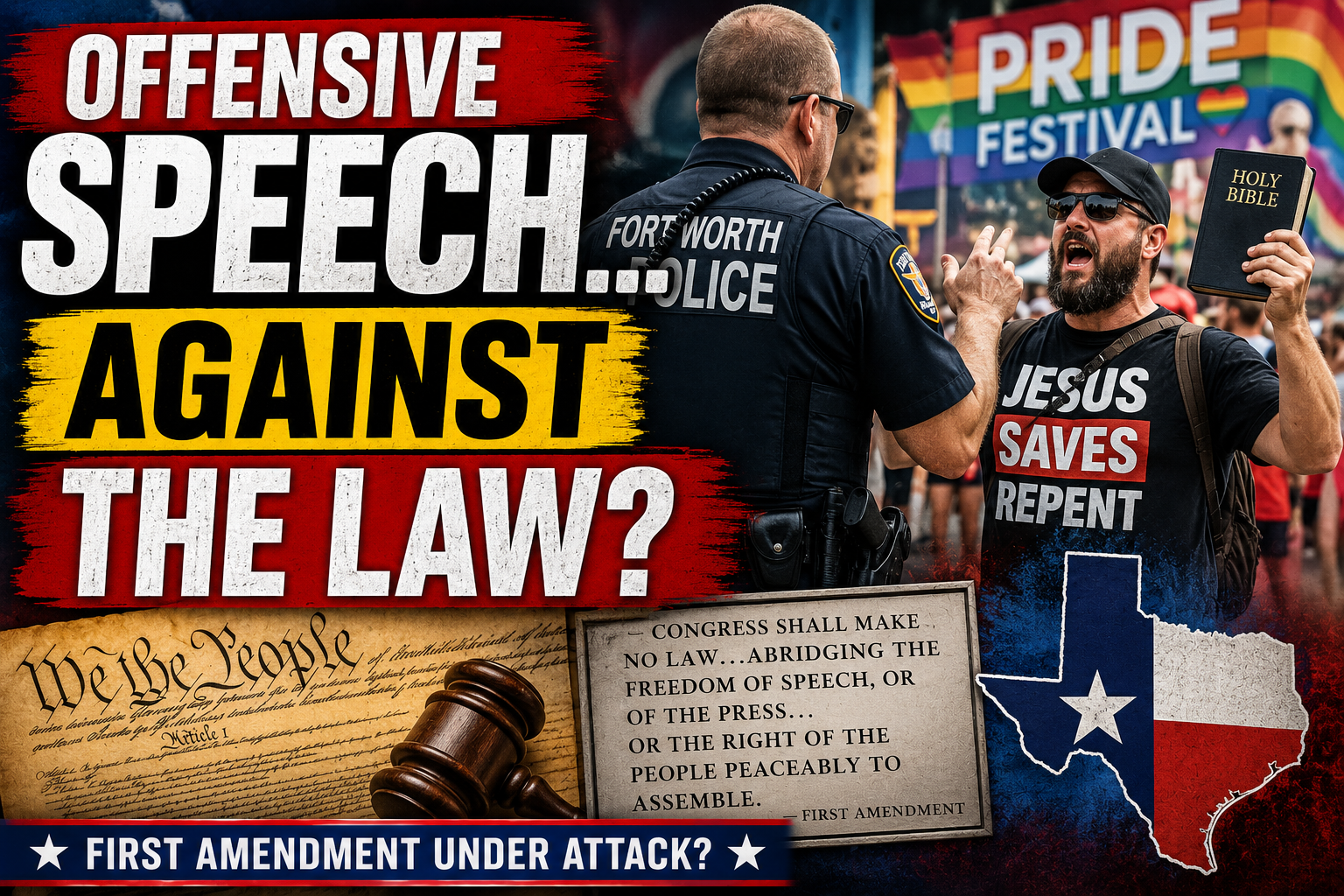
A confrontation between Texas police officers and Christian street preachers outside a Pride festival has ignited a nationwide debate over free speech, religious liberty, and the limits of government authority.
The incident occurred on June 27 outside the Trinity Pride Festival in Fort Worth, Texas. Videos recorded by the street preachers show officers discussing whether certain speech—particularly comments about gender identity—could lead to citations if another person claimed to be offended.

In one exchange, a preacher asked an officer whether calling a biological male “sir” after the individual identified as a woman could result in a citation if that person became offended.
The officer initially responded that it was “a gray area” before explaining that repeatedly saying something after someone expressed offense could become “potentially” citable as offensive language.
In a separate exchange captured on video, another officer answered “Yes, absolutely,” when asked whether someone could be ticketed for offensive speech, adding that it would fall under disorderly conduct. The videos quickly spread across social media, drawing millions of views and criticism from free speech advocates.
The Fort Worth Police Department later clarified the situation. According to department officials, one individual was cited during the event, but the citation was issued for excessive noise under the city’s noise ordinance—not for the content of the person’s speech. The department also announced that officers would receive additional training on First Amendment protections after reviewing the incident.
Constitutional scholars have long noted that the First Amendment protects speech that others may find offensive. While certain categories of speech—such as true threats, incitement to imminent lawless action, or harassment in specific legal contexts—can lose constitutional protection, speech generally does not become illegal simply because another person is offended.
That principle has repeatedly been affirmed by the U.S. Supreme Court.
The controversy has drawn criticism from both conservative commentators and civil liberties advocates, many of whom warned that allowing government officials to decide what qualifies as “offensive” speech creates a dangerous precedent.
For Christians, the issue reaches beyond politics.
The apostle Paul often preached messages that offended religious leaders and government authorities alike.
Jesus Himself warned His followers that His message would be rejected by many.
John 15:18 reminds believers: “If the world hates you, you know that it has hated Me before it hated you.” (NASB 1995)
Likewise, Acts 5:29 declares: “We must obey God rather than men.”
These verses do not give Christians permission to be rude or hateful. Scripture repeatedly commands believers to speak “the truth in love” (Ephesians 4:15). Christians should be known for both conviction and compassion.
Yet there is an important distinction between offensive behavior and offensive ideas.
Throughout history, many of Christianity’s central teachings have offended prevailing cultural values. The exclusivity of Christ, the reality of sin, the call to repentance, and God’s design for marriage and sexuality have often been unpopular messages.
Charles Spurgeon once observed:
“The same sun that melts the wax hardens the clay.”
The gospel will always produce different responses.
Whether someone agrees with the street preachers or not, the First Amendment exists precisely to protect unpopular speech. If government officials can silence speech simply because it offends someone, then every American’s liberty is at risk.
The Fort Worth Police Department deserves credit for publicly clarifying that the citation involved noise rather than viewpoint and for providing additional First Amendment training to its officers. At the same time, the incident serves as an important reminder that constitutional freedoms require constant vigilance.
Christians should pray for wisdom, courage, and grace as they continue proclaiming the Gospel in an increasingly divided culture. The message of Christ has always challenged the world—and faithful believers should expect nothing less.