
For the past several years, Americans have been told that artificial intelligence is the future.
It will make us more productive. It will revolutionize medicine. It will transform education. It will help businesses operate more efficiently, accelerate scientific discoveries, and give ordinary Americans capabilities that once belonged only to enormous corporations.
Much of that may prove true.
But something interesting is happening as artificial intelligence moves from Silicon Valley demonstrations into everyday American life.
Americans are becoming increasingly skeptical.
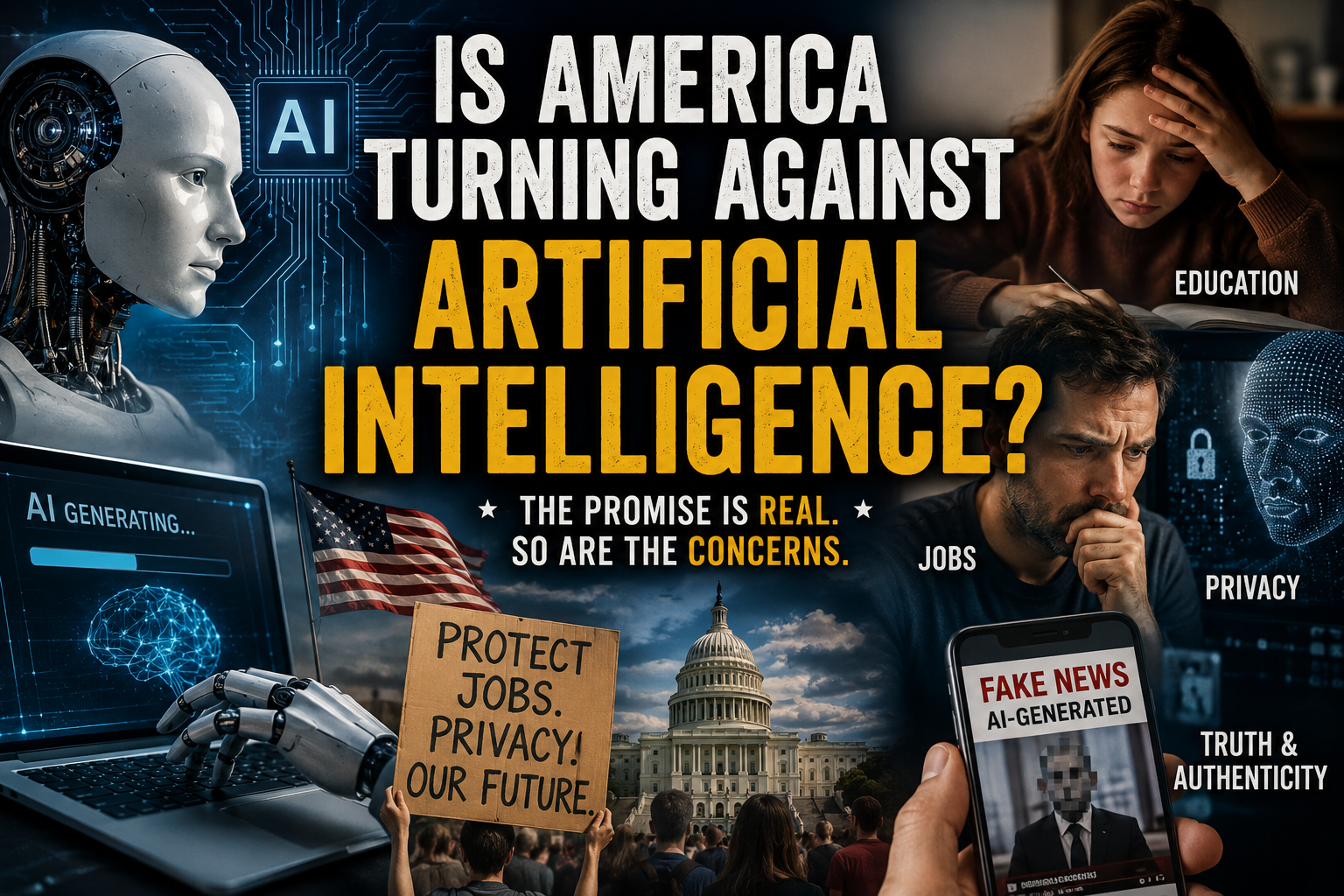
The concern is no longer limited to science-fiction fears about intelligent machines. People are asking practical questions about their jobs, their children’s education, their privacy, their personal information, the authenticity of what they see online, and how much control a handful of technology companies should have over a technology this powerful.
The AI revolution is still moving forward.
But America’s honeymoon with artificial intelligence may already be ending.
Americans Are Becoming More Concerned About AI
The numbers are difficult to ignore.
Research published by the Pew Research Center found that half of American adults said the increasing use of artificial intelligence in everyday life made them more concerned than excited. Only about one in ten said they were more excited than concerned.
That represents a substantial change from several years earlier, when considerably fewer Americans expressed greater concern than excitement.
Another major survey released in 2026 by Bentley University and Gallup found that attitudes toward artificial intelligence had recently become more skeptical after previously showing signs of improvement.
Americans aren’t necessarily rejecting technology.
They may instead be rejecting the idea that every technological advancement should automatically be accepted simply because Silicon Valley says it represents progress.
That distinction matters.
The Job Question Is Getting Harder to Ignore
For millions of Americans, the biggest concern is straightforward:
Will artificial intelligence eventually replace me?
AI companies frequently emphasize that artificial intelligence will create new jobs while transforming existing ones.
History provides some reason to believe them.
Technological revolutions have repeatedly eliminated certain jobs while creating entirely new industries. Automobiles displaced many jobs connected to horses and carriages but created enormous industries around manufacturing, transportation, energy, insurance, tourism, construction, and logistics.
The internet eliminated some businesses while creating millions of opportunities that previously did not exist.
Artificial intelligence may ultimately follow a similar pattern.
But that does not make today’s concerns irrational.
Research from the Society for Human Resource Management in 2026 found that roughly 20% of U.S. wage and salary employment was already at least 50% automated, while approximately 21% of employment involved work that was at least half performed using AI tools.
Importantly, the same research found that high near-term job displacement risk remained considerably more limited than those numbers might initially suggest.
In other words, AI is changing work rapidly, but there is not yet evidence that machines are eliminating American employment on the massive scale some predictions suggest.
Yet.
The responsible position isn’t panic.
Nor is it pretending nothing is happening.
America needs workers prepared for an economy in which artificial intelligence becomes a tool used across thousands of occupations.
Parents Are Asking a Different Question
For parents, employment may not even be the biggest concern.
Education is.
Children now have access to technology capable of writing essays, answering homework questions, solving mathematical problems, summarizing books, generating research, and producing presentations within seconds.
That sounds extraordinary.
It also raises an uncomfortable question:
What happens when the machine starts doing the thinking children are supposed to be learning how to do?
One of the world’s leading artificial-intelligence researchers, Stanford professor Fei-Fei Li, recently warned that one of the greatest educational risks from AI is undermining students’ motivation and autonomy in learning.
AI can be an extraordinary tutor.
But there is an enormous difference between using artificial intelligence to help understand algebra and asking artificial intelligence to complete the algebra assignment.
One strengthens the student.
The other can replace the intellectual struggle through which learning actually occurs.
Parents should be involved in determining where that line is drawn.
Then There Is Privacy
This may ultimately become one of the largest issues surrounding artificial intelligence.
AI becomes increasingly useful when it knows more about you.
Your preferences.
Your habits.
Your purchases.
Your location.
Your conversations.
Your interests.
Your health information.
Your relationships.
But usefulness and privacy can quickly come into conflict.
A 2026 Pew Research Center survey found that roughly seven in ten Americans believe artificial intelligence will make their personal information less secure. Only a tiny percentage believed AI would actually make their information more secure.
That concern deserves to be taken seriously.
Americans should not have to surrender meaningful privacy simply to participate in modern society.
Can We Still Believe What We See?
There is another problem that may prove even more culturally disruptive.
Artificial intelligence can now generate remarkably convincing photographs, voices, music, articles, and video.
That capability will improve.
Imagine receiving a video apparently showing a politician making an outrageous statement.
Is it real?
Imagine hearing an audio recording supposedly capturing a CEO admitting wrongdoing.
Is it authentic?
Imagine receiving a telephone call that sounds exactly like a family member asking for emergency money.
Is it actually them?
For generations, Americans were taught not to believe everything they read.
We are entering an era where we may also need to learn not to believe everything we see and hear.
That represents an enormous societal change.
Americans Don’t Trust Washington to Fix It
Ordinarily, a technology creating concerns this significant would lead to demands for government regulation.
But Americans have another problem.
They don’t particularly trust the government either.
Pew Research Center reported in June 2026 that 67% of Americans had little or no confidence that the federal government could effectively regulate artificial intelligence.
At the same time, approximately six in ten Americans lacked confidence that U.S. companies would develop and use AI responsibly.
That creates an extraordinary situation.
Americans are skeptical of the corporations developing artificial intelligence while simultaneously being skeptical of the government officials who might regulate those corporations.
And frankly, there are good reasons for both concerns.
Giving Washington enormous authority over artificial intelligence could create its own dangers involving censorship, surveillance, bureaucracy, and political favoritism.
But allowing a handful of enormous corporations to establish the rules themselves isn’t a free-market solution either.
A genuinely competitive free market requires transparency, competition, property rights, accountability, and meaningful consumer choice.
The Answer Isn’t to Stop AI
America cannot simply opt out of artificial intelligence.
Nor should we.
AI has enormous potential.
Doctors may use it to identify diseases earlier.
Scientists may discover treatments faster.
Small businesses may gain capabilities previously available only to corporations with enormous staffs.
Farmers may increase productivity.
Manufacturers may become more competitive.
People with disabilities may gain extraordinary new tools for independence.
American entrepreneurs may build industries we cannot yet imagine.
And there is a national-security reality that cannot be ignored.
If America abandons artificial intelligence, China will not.
The United States should remain the world’s leader in AI development.
But leadership does not require blind acceptance of everything technology companies want to build.
Technology Should Remain a Tool
Perhaps the most important question surrounding artificial intelligence isn’t whether AI becomes more intelligent.
It is whether human beings become too dependent on it.
A calculator is extraordinarily useful.
But children still need to understand mathematics.
GPS is extraordinarily useful.
But anyone who has blindly followed GPS onto the wrong road understands the danger of surrendering judgment to a machine.
Artificial intelligence should operate according to the same principle.
Use the tool. Don’t surrender your judgment to the tool.
Americans should learn AI.
Businesses should understand it.
Parents should understand what their children are doing with it.
Schools should teach students how to use it responsibly without allowing it to replace learning.
Workers should develop skills that allow them to work alongside it.
And citizens should insist on transparency when government agencies or corporations use artificial intelligence to make decisions affecting their lives.
This Isn’t a Rejection of Progress
There is something deeply American about questioning powerful new institutions.
Americans have never been required to choose between embracing every new technology without question and rejecting technological progress entirely.
There is another option.
We can innovate aggressively while protecting liberty.
We can build powerful technologies while protecting children.
We can embrace productivity while protecting privacy.
We can support American technology companies while opposing corporate favoritism.
We can compete with China without allowing technological competition to become an excuse for abandoning fundamental American principles.
Artificial intelligence should expand human capability — not diminish human responsibility.
It should help people think — not eliminate the need to think.
It should expand opportunity — not concentrate unprecedented power in the hands of a few corporations or government agencies.
So perhaps America isn’t actually turning against artificial intelligence.
Perhaps Americans are beginning to ask a more important question:
What kind of artificial-intelligence future do we actually want?
That conversation is overdue.