

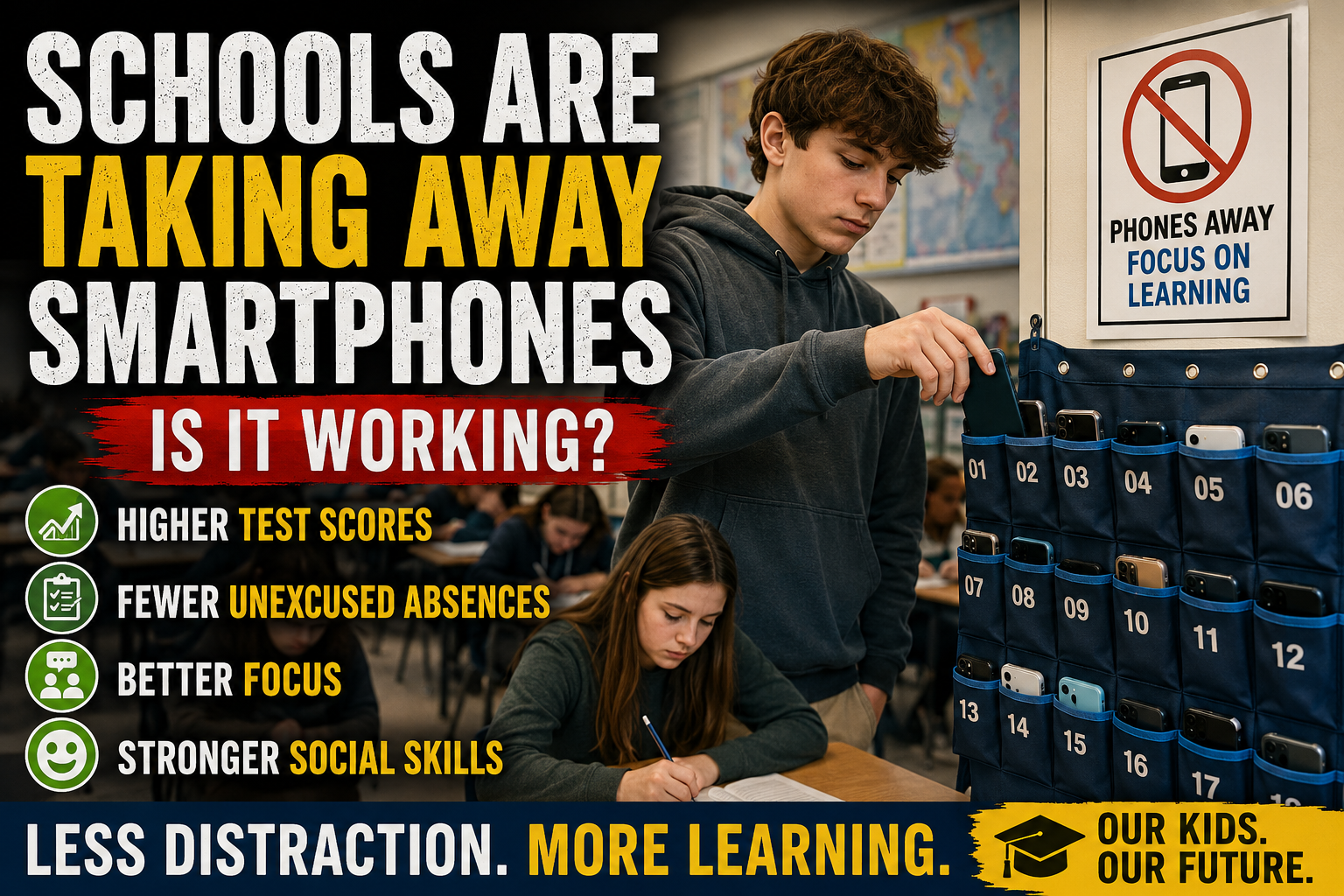
For years, parents and teachers have watched something remarkable happen inside American classrooms.
Students may be physically sitting behind a desk, but mentally they can be somewhere else entirely.
Text messages.
TikTok.
YouTube.
Snapchat.
Games.
Group chats.
Notifications arriving throughout the school day.
Now schools across America are trying something that would have seemed completely ordinary just a generation ago:
They’re asking students to put the phones away.
In some schools, smartphones must remain inside backpacks. Others require students to place them in classroom storage systems. Some districts have gone considerably further, restricting access from the first bell until dismissal.
The idea is simple.
For six or seven hours a day, school should once again be a place where children learn, talk to one another, interact with teachers, and experience life without constantly reaching for a screen.
But is it actually working?
Increasingly, the evidence suggests that removing smartphones from the classroom may have real benefits.
The Distraction Problem Is Difficult to Deny
Whatever Americans may disagree about regarding education, it is becoming increasingly difficult to argue that smartphones aren’t distracting students.
Federal education data found that 73% of public-school leaders believed cellphone use had negatively affected students’ attention spans.
More than half — 53% — said phones had negatively affected academic performance.
And 72% said cellphone use had negatively affected students’ mental health.
Those are extraordinary numbers.
They also shouldn’t surprise many parents.
Adults understand how difficult it can be to ignore a buzzing phone sitting beside them during a meeting.
Now imagine being fourteen years old.
Your friends are messaging you.
A social-media notification appears.
Someone has posted a new video.
A group chat is exploding with messages.
And meanwhile, a teacher is explaining algebra.
Which one is designed by some of the world’s most sophisticated technology companies to capture your attention?
The answer is obvious.
Early Evidence Suggests Bans Can Help
The important question isn’t whether smartphones are distracting.
It’s whether banning them actually improves education.
New research provides some encouraging evidence.
A recent study examining school cellphone restrictions found that test scores improved following implementation of a ban, with the largest gains appearing during the second year.
Overall test scores improved modestly, while the improvement among middle- and high-school students was larger.
The researchers also found reductions in unexcused absences.
That matters because it suggests something broader may be occurring.
Removing phones doesn’t merely prevent students from checking social media during math class.
It may change the culture of the school.
Students become more present.
Teachers spend less time policing devices.
And students may become more engaged with the people physically around them.
None of this proves that a cellphone ban magically fixes American education.
It doesn’t.
But when schools are struggling with attention, discipline, attendance, and academic achievement, removing one of the most powerful distractions ever placed in a child’s pocket seems like common sense.
Parents Increasingly Support Restrictions
Parents and other adults appear to recognize the problem.
A Pew Research Center survey found that 74% of American adults supported prohibiting middle- and high-school students from using cellphones during class.
Support becomes more divided when the restriction extends throughout the entire school day, including lunch and time between classes.
But Americans also tend to believe full-day restrictions could improve important outcomes.
Majorities said such bans would positively affect students’ grades, social skills, and classroom behavior.
That raises an interesting possibility.
Maybe Americans aren’t simply worried about phones interfering with education.
Maybe we’re beginning to recognize what smartphones have done to childhood itself.
Remember What School Used to Look Like?
Think about a school cafeteria twenty-five or thirty years ago.
It was loud.
Students talked.
They laughed.
They argued.
They told stories.
They developed friendships.
They learned how to navigate awkward conversations and social situations.
Those interactions weren’t wasted time.
They were part of growing up.
Today, it isn’t unusual to see groups of young people sitting together while each person stares at a separate screen.
Something has been lost.
Human beings learn social skills by being social.
Children learn conversation by having conversations.
They learn how to read facial expressions by looking at faces.
They learn how to resolve disagreements by experiencing disagreements.
No app can fully reproduce that education.
Teenagers Aren’t Nearly as Enthusiastic
There is, of course, another side to this debate.
Students generally aren’t thrilled about having their phones taken away.
Pew found that 41% of teenagers supported classroom cellphone bans, while 51% opposed them.
When asked about banning phones for the entire school day, support fell dramatically. Only 17% of teenagers supported an all-day restriction, while 73% opposed it.
That’s not particularly surprising.
If adults were told tomorrow that their employers were collecting their smartphones at the office entrance, many of them wouldn’t be happy either.
But adults and children don’t occupy the same role.
Parents routinely make decisions their children dislike because parenting isn’t a popularity contest.
Schools have a similar responsibility while students are in their care.
The relevant question isn’t whether teenagers enjoy the rule.
The relevant question is whether the rule helps create an environment where they can learn.
What About Emergencies?
The strongest argument against school cellphone bans involves safety.
Parents understandably want the ability to reach their children.
America has experienced school shootings, severe weather, medical emergencies, and other frightening events.
Telling a parent that he or she cannot immediately contact a child can feel unreasonable.
Schools should take that concern seriously.
A sensible cellphone policy therefore doesn’t necessarily require confiscating every device and making communication impossible.
Students could be allowed to carry phones while being prohibited from using them during instructional periods.
Schools can establish emergency procedures allowing immediate access when necessary.
Parents should also have clear ways to contact the school when a genuine emergency arises.
There is room for reasonable compromise.
But an emergency exception should not become an excuse for unrestricted access to social media throughout the school day.
This Should Not Become Another Washington Mandate
There is another important principle here.
America is enormous.
A rural Oklahoma school with several hundred students may face different circumstances from a massive urban high school.
Parents, teachers, principals, school boards, and communities should have significant authority to determine policies appropriate for their schools.
We don’t need Washington micromanaging when a teenager in Broken Arrow can look at Instagram.
Local control matters.
But local control also requires adults to actually exercise leadership.
If teachers cannot teach because students are constantly distracted by smartphones, school administrators shouldn’t be afraid to establish boundaries.
And parents shouldn’t automatically undermine teachers when their child complains about losing access to a phone for forty-five minutes.
The Larger Question Is About Childhood
The smartphone debate extends far beyond schools.
American children are growing up inside a technological experiment unlike anything previous generations experienced.
They carry devices capable of delivering entertainment, pornography, social validation, bullying, advertising, misinformation, games, messaging, and endless algorithmically selected content twenty-four hours a day.
And we handed them these devices before we fully understood what they might do.
That doesn’t make smartphones evil.
They are extraordinary tools.
They allow parents to locate their children, families to communicate instantly, students to access information, and people to call for help during emergencies.
The problem isn’t the existence of the technology.
The problem is allowing the technology to control the environment.
Maybe School Should Be Different
There is something appealing about creating one part of a child’s day where the expectation is simple:
Be here.
Listen.
Learn.
Talk to the person sitting beside you.
Look your teacher in the eye.
Allow yourself to become bored occasionally.
Solve a problem without immediately asking a device for the answer.
Those aren’t outdated ideas.
They are fundamental human experiences.
America doesn’t need to abandon technology.
Our children need to understand technology because they will inherit a world increasingly shaped by artificial intelligence, automation, robotics, and digital communication.
But understanding technology also means learning when not to use it.
Perhaps that is one of the most important lessons schools can teach.
Early evidence suggests cellphone restrictions can improve attention, attendance, and academic performance.
More research will tell us how large and lasting those benefits ultimately become.
But parents don’t need a ten-year study to recognize one basic truth:
A child’s attention is valuable.
Schools should protect it.