
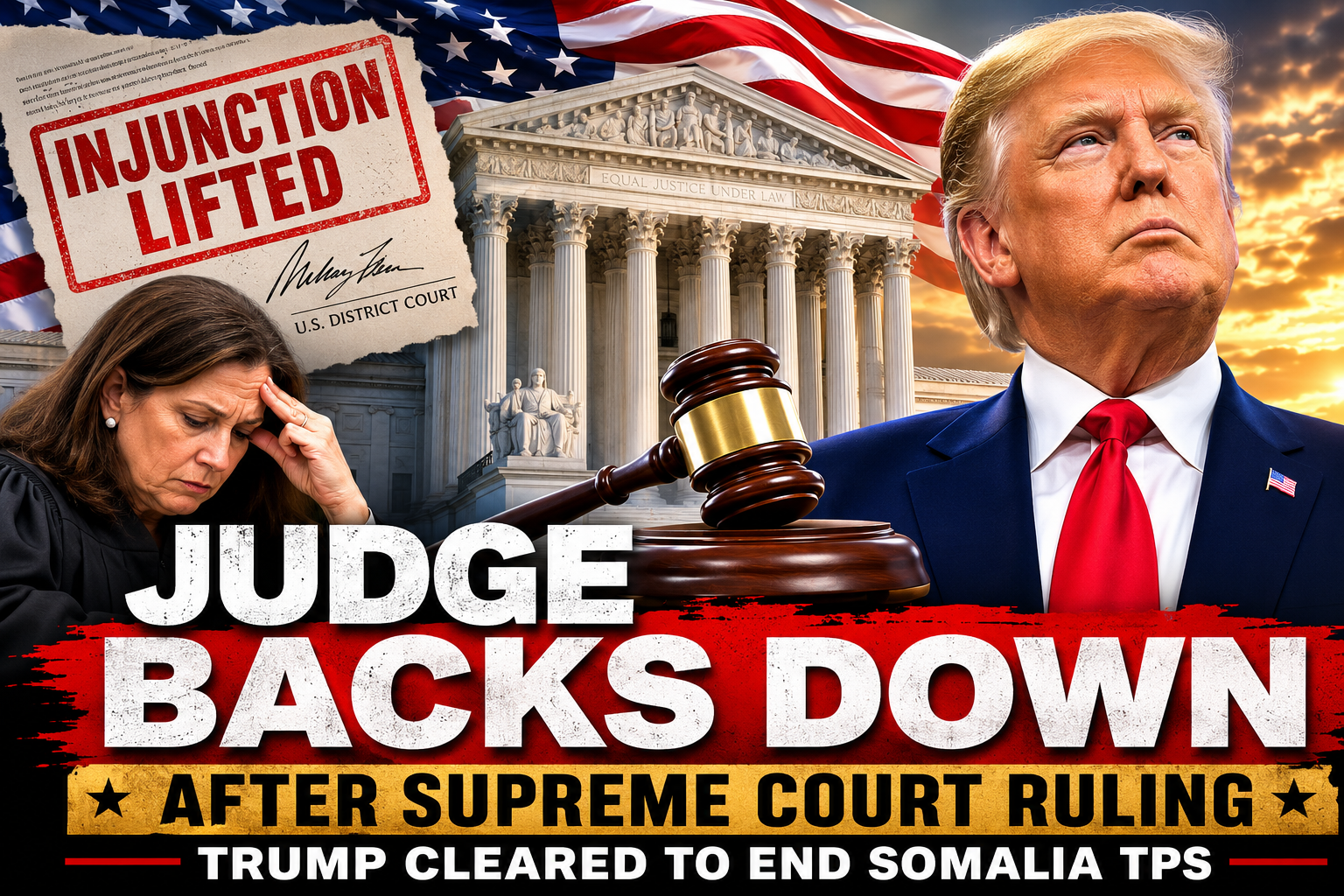
A federal judge who previously prevented the Trump administration from ending Temporary Protected Status for Somali nationals has now lifted her own stay, clearing the way for the administration to proceed.
But the significance of the ruling reaches well beyond Somalia or even immigration.
It raises one of the most important constitutional questions confronting America today:
How much authority should a single federal district judge have to stop policies adopted by the executive branch when Congress has explicitly limited judicial review?
U.S. District Judge Allison Burroughs of Massachusetts lifted the stay on August 14 after the Supreme Court issued a major ruling in June involving similar efforts by the Trump administration to terminate Temporary Protected Status, commonly known as TPS.
Burroughs had previously prevented the Department of Homeland Security from implementing the Somalia termination while litigation continued.
Then the Supreme Court changed the legal landscape.
The Supreme Court Changes the Equation
The Supreme Court ruled 6-3 in June in litigation involving the Trump administration’s efforts to terminate TPS protections for Haiti and Syria.
At the center of the dispute was language Congress placed into federal immigration law restricting judicial review of certain decisions involving Temporary Protected Status.
The Court concluded that federal law generally prevents courts from reviewing non-constitutional challenges to the Homeland Security secretary’s decisions regarding TPS termination.
The Supreme Court also concluded that an equal-protection challenge raised in the Haiti litigation was unlikely to succeed.
That became extremely important in the Somalia case.
Somali plaintiffs had advanced a similar constitutional argument, alleging that the administration’s decision was motivated by racial or national-origin discrimination.
After the Supreme Court ruling, Burroughs had to reconsider whether those plaintiffs were likely to prevail.
Ultimately, she concluded that the Supreme Court precedent constrained her analysis.
The judge wrote that she was bound to evaluate the dispute through what she called the Supreme Court’s new legal “prism.”
And that changed the outcome.
The Judge Lifts Her Own Stay
That’s what makes this case particularly interesting.
Burroughs wasn’t overturning another judge.
She was lifting her own stay.
The judge remained concerned about the potential consequences for Somali TPS beneficiaries and concluded that the plaintiffs had demonstrated the possibility of irreparable harm.
But that’s only part of the legal test required for an injunction.
The plaintiffs also needed to demonstrate a sufficient likelihood of succeeding on the merits of their claims.
After the Supreme Court’s decision, Burroughs concluded they could not meet that requirement.
As a result, the stay was lifted and the Trump administration can proceed with terminating Somalia’s TPS designation unless another court intervenes.
Somalia’s “Temporary” Status Began in 1991
There is another remarkable part of this story that deserves attention.
Somalia was first designated for Temporary Protected Status in 1991.
TPS was created by Congress to protect eligible foreign nationals already present in the United States when extraordinary conditions such as armed conflict or natural disaster temporarily make returning home unsafe.
It does not itself provide permanent residency or citizenship.
Somalia received the designation as civil war devastated the country.
Successive presidential administrations extended the protection repeatedly.
By 2026, Somalia’s supposedly temporary designation had existed for approximately 35 years.
That exposes a much larger problem with Washington.
Temporary government programs have a remarkable tendency to become permanent.
A humanitarian protection lasting several months or several years is understandable.
When a temporary policy survives for three and a half decades, Americans are justified in asking whether the word “temporary” still means anything.
What the Trump Administration Decided
The Department of Homeland Security announced in January that Somalia’s TPS designation would terminate effective March 17, 2026.
According to the official Federal Register notice, DHS reviewed conditions in Somalia and consulted appropriate government agencies before determining that the country no longer continued to satisfy the statutory conditions required for the designation.
The administration therefore concluded that the designation should terminate.
That decision was immediately controversial.
Somalia continues to face serious instability and terrorist violence, including threats from the Islamist militant organization al-Shabaab.
Immigration advocates argue that returning some Somali nationals could therefore expose them to dangerous conditions.
Those humanitarian concerns are legitimate matters for policymakers to consider.
But humanitarian concern and legal authority are two separate questions.
A judge can believe that someone may experience hardship without necessarily possessing statutory authority to prevent the executive branch from carrying out a policy Congress authorized it to administer.
That distinction became central to this case.
How Many People Are Actually Affected?
Headlines about immigration frequently create the impression that a ruling affects every immigrant from a particular country.
That isn’t what happened here.
Reuters reported that nearly 1,100 Somali nationals were covered by the protections at issue.
Ending Somalia’s TPS designation does not mean every Somali immigrant living in America faces deportation.
American citizens of Somali ancestry are obviously unaffected.
Some Somali immigrants may possess permanent residency, asylum, another visa classification, or another lawful basis for remaining in the United States.
TPS is a specific immigration classification.
Those whose ability to remain depends solely upon that designation face a substantially different situation when the protection ends.
The Bigger Fight Over Federal Judges
The ruling arrives during a much larger battle over judicial power.
Trump administration policies have repeatedly encountered injunctions, stays, and temporary restraining orders issued by federal district judges.
Defenders of aggressive judicial review make an important argument: courts exist partly to ensure presidents do not exceed the authority granted to them by the Constitution and Congress.
That’s true.
No president should be above the law.
But neither should individual federal judges.
The judiciary is not an unelected legislature empowered to substitute its preferred policies for those adopted by the elected branches.
There is a difference between declaring an executive action unlawful and simply disagreeing with the policy.
That distinction is essential to constitutional government.
Congress Matters Too
This dispute also reminds Americans that not every political controversy is simply a battle between the president and judges.
Congress matters.
Congress created Temporary Protected Status.
Congress established the statutory framework governing it.
And Congress placed restrictions on judicial review of certain TPS determinations.
The executive branch then administers that law through the Department of Homeland Security.
The courts interpret the law and resolve legitimate constitutional disputes.
That separation of powers is not a technicality.
It is one of the central protections of American liberty.
When any one branch accumulates too much authority, the constitutional balance begins to break down.
The Supreme Court Did Not Give Presidents Unlimited Power
It’s also important not to exaggerate what the Supreme Court decided.
The Court did not declare that presidents are immune from judicial review.
It did not eliminate every possible constitutional challenge to TPS decisions.
And it did not announce that federal courts can never stop an unlawful executive action.
The ruling was considerably narrower.
The Court interpreted the restrictions Congress placed on judicial review of TPS decisions and addressed the likelihood of success of the equal-protection argument presented in the litigation before it.
That distinction matters.
Conservatives should demand constitutional limits even when the president involved is someone they support.
The principle should remain the same regardless of which political party controls the White House.
A 35-Year Temporary Program Raises Questions
There is still a policy question Congress should confront.
If conditions in a country remain dangerous for decades, should the United States continue extending temporary protection indefinitely?
Perhaps Congress believes some people deserve a different permanent immigration status.
If so, Congress should debate that question openly and legislate accordingly.
What government should avoid is using temporary classifications as substitutes for permanent immigration decisions because elected officials don’t want to confront politically difficult questions.
Thirty-five years is an extraordinary definition of temporary.
Americans deserve immigration laws whose words actually mean what they say.
The Constitutional Lesson
The most important part of this story isn’t simply that the Trump administration received another immigration victory.
It’s what happened institutionally.
A federal district judge blocked an executive policy.
The Supreme Court subsequently clarified the governing law.
The plaintiffs attempted to continue their challenge under constitutional theories.
The district judge reconsidered the case under that controlling precedent and ultimately lifted her own stay.
That is how a judicial hierarchy is supposed to function.
Judges are independent.
But lower courts are still bound by the Supreme Court.
Presidents possess substantial executive authority.
But presidents remain bound by the Constitution and statutes enacted by Congress.
Congress writes the laws.
But Congress itself remains constrained by the Constitution.
America’s system intentionally divides power because the Founders understood something about human nature that remains true more than two centuries later:
Power needs limits.
That principle applies to presidents.
It applies to Congress.
And yes, it applies to judges too.
The Somalia TPS dispute isn’t finished in every respect. The underlying constitutional litigation may continue.
But the immediate question has changed.
The Trump administration is now free to proceed with terminating Somalia’s decades-old TPS designation unless further judicial action intervenes.
And the case provides another reminder of a basic feature of America’s constitutional order:
A district court can challenge an administration. But when the Supreme Court establishes controlling precedent, lower courts have to follow it.