For most of the past few years, Americans have been asking the same question about artificial intelligence:
Is AI going to take my job?
It’s a legitimate concern. Artificial intelligence is rapidly becoming capable of performing tasks that once required writers, designers, researchers, programmers, marketers and other skilled workers.
But I think there’s another side of this story that deserves considerably more attention.
What happens when millions of ordinary Americans realize what AI allows them to do?
We may be entering an era in which the advantage doesn’t necessarily belong to the person with the largest staff or biggest budget.
It may belong to the person who learns how to use these new tools effectively.
The Rise of the One-Person Company
I’ve spent much of my adult life building businesses, and anyone who has tried it knows that having an idea is usually the easy part.
Executing it is harder.
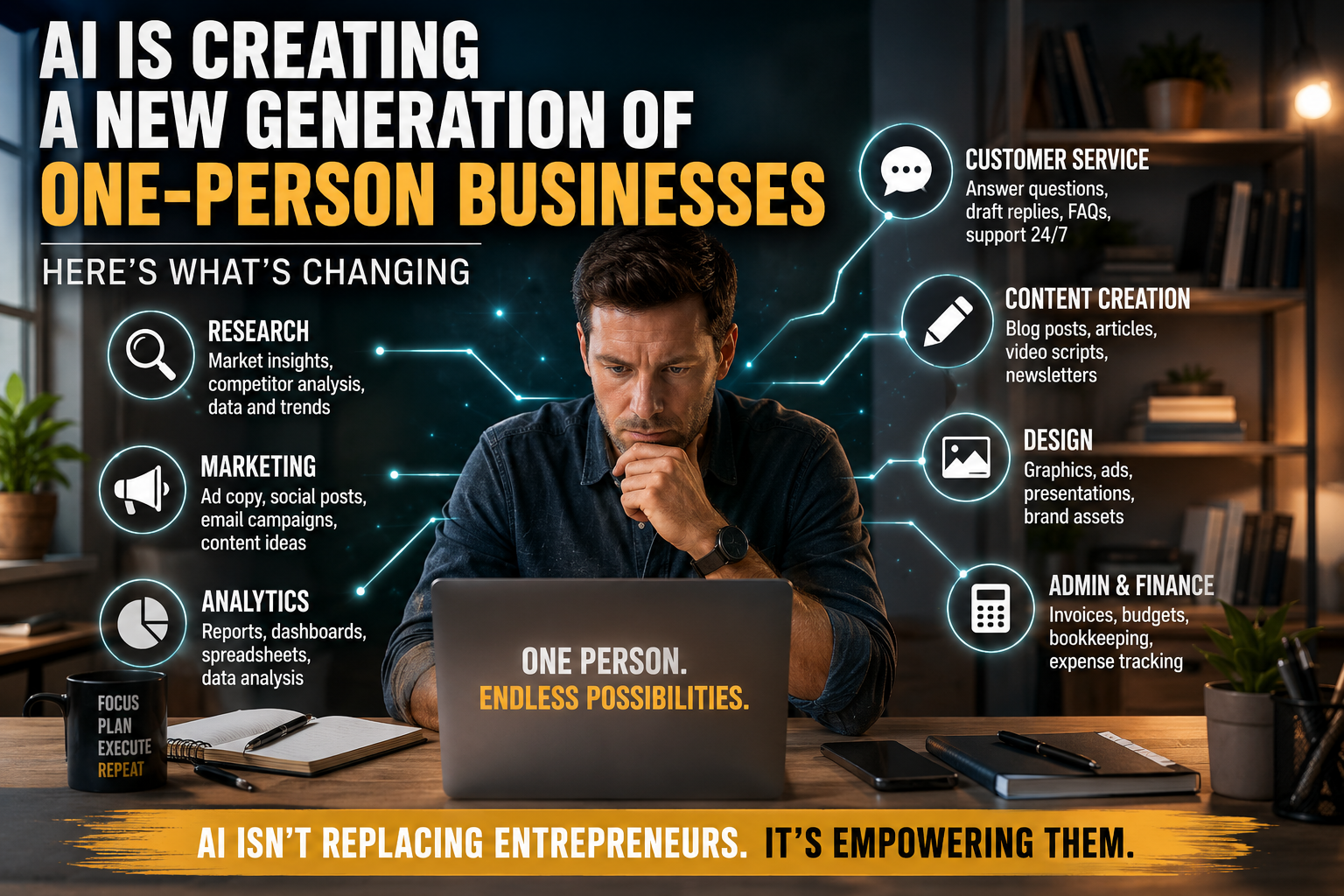
You need marketing. Research. Graphics. A website. Customer service. Accounting. Technology. Sales.
Suddenly, your simple business idea requires ten different skills and considerably more money than you anticipated.
AI is beginning to change that equation.
One entrepreneur with a laptop can now use artificial intelligence to research an industry, analyze competitors, brainstorm products, develop marketing campaigns, draft website content, analyze spreadsheets, troubleshoot software and organize information.
Does that mean AI can successfully run your business for you?
Absolutely not.
AI makes mistakes. It can misunderstand what you’re asking and sometimes provide incorrect information with remarkable confidence.
Human judgment remains essential.
The real opportunity is leverage.
A tractor gave farmers leverage.
Power tools gave craftsmen leverage.
The Internet gave small businesses access to customers around the world.
AI is giving individuals a new kind of intellectual leverage.
What Happens When Starting Gets Cheaper?
Imagine someone sitting at a kitchen table in Oklahoma with a business idea.
Twenty years ago, that person’s location, finances and professional network could determine whether the idea ever got beyond the kitchen table.
Today, geography matters less.
And AI may reduce another barrier: the cost of expertise.
That doesn’t mean expertise becomes unnecessary. Quite the opposite. But it may allow one knowledgeable person to accomplish dramatically more.
And that leads to a possibility we aren’t discussing enough:
AI may not simply replace workers. AI may multiply entrepreneurs.
When the cost of experimenting with an idea falls, more people can afford to experiment.
Most ideas won’t become successful businesses.
But some will.
And businesses that might have required five employees could potentially begin with one.
There’s Another Side to the Revolution
That opportunity also creates disruption.
AI doesn’t have to eliminate an entire occupation to affect employment.
Most jobs are collections of tasks.
Suppose artificial intelligence can perform 25 percent of someone’s workload. Eventually, a company may discover that four employees using AI can accomplish what previously required five.
Multiply that across thousands of businesses and the consequences become significant.
There’s also a problem for young workers.
Entry-level work is where people gain experience.
Writers learn by writing.
Salespeople learn by talking to customers.
Programmers learn by solving problems.
If AI increasingly handles beginner-level work, businesses will need to reconsider how inexperienced employees become experienced ones.
Experience Could Become an Advantage
Americans in their 40s, 50s and 60s shouldn’t assume this revolution belongs only to younger generations.
AI has access to enormous amounts of information.
But it doesn’t have your life experience.
It hasn’t spent thirty years dealing with customers.
It hasn’t raised a family, managed employees, built a company, survived a failure or learned from decades of mistakes.
Experience creates context.
Combine that experience with AI and something interesting happens.
The future may not simply be humans competing against artificial intelligence.
Increasingly, it may be people using AI competing with people who aren’t.
So don’t try to beat artificial intelligence at being artificial intelligence.
Develop the things that remain distinctly human: judgment, relationships, character, leadership, creativity, responsibility and trust.
Then learn how to use the machine.
Because artificial intelligence isn’t simply changing the way Americans work.
It may be changing who gets ahead.
Keep the conversation going
Get new Eric Thompson Show episodes and stories about AI, culture, faith, family and business in your inbox.
Join the ETT newsletter →Free to join. Unsubscribe anytime.

Author: Eric Thompson
Eric Thompson hosts The Eric Thompson Show from Broken Arrow, Oklahoma, exploring faith, family, culture, AI and business through a Christian worldview.