

By ET News
Every time an American asks an artificial intelligence chatbot a question, streams a movie, stores photographs online, checks a bank account, searches Google, or opens a social media app, the request travels through a largely invisible network of powerful computers.
Those computers are housed inside buildings known as data centers.
For years, data centers operated quietly behind the scenes of America’s digital economy. Now, the artificial intelligence boom is transforming them into some of the largest and most controversial industrial developments in the country.
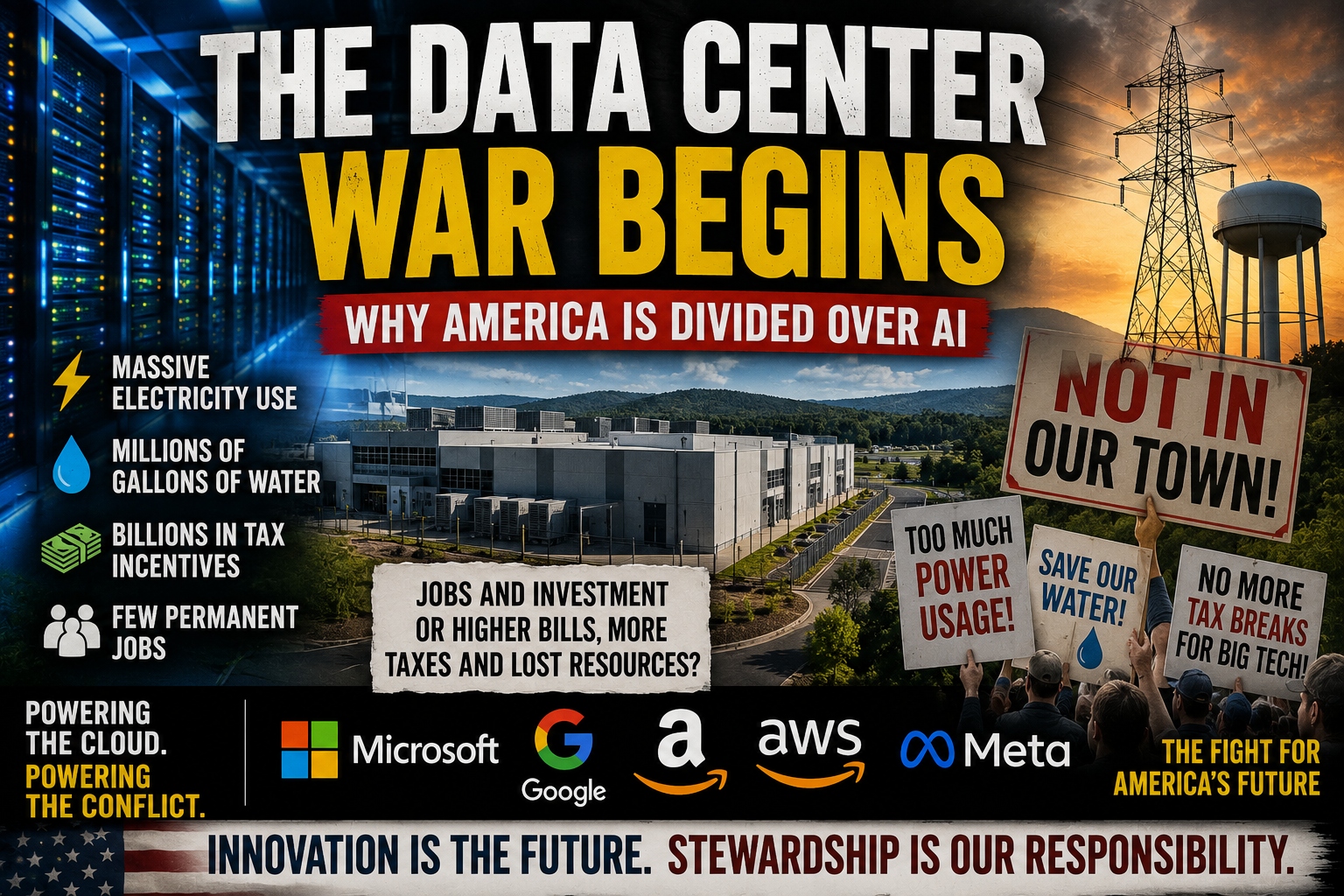
Technology companies and government leaders describe data centers as essential infrastructure for economic growth, national security, scientific research, cloud computing, and America’s competition with China. Supporters promise billions of dollars in investment, construction jobs, expanded tax bases, and access to the technology that will shape the future.
Opponents see something very different: enormous industrial complexes consuming vast amounts of electricity and water, receiving generous tax incentives, producing relatively few permanent jobs, and changing rural communities without sufficient public input.
The result is a rapidly expanding national conflict over who will benefit from the artificial intelligence revolution—and who will be expected to pay its costs.
What Is a Data Center?
A data center is a secure building or campus filled with computer servers, networking equipment, storage systems, cooling machinery, electrical infrastructure, and backup generators.
Imagine a massive warehouse similar in size to a large retail distribution center. Instead of shelves filled with merchandise, however, the building contains long rows of computers operating around the clock.
These computers store, process, and transmit digital information. They support websites, banking systems, medical records, email services, government databases, streaming platforms, online shopping, mobile applications, and cloud-based business tools.
The “cloud” is not an invisible object floating somewhere above the earth. It is a network of physical servers located in real buildings, using real land, electricity, water, wiring, and industrial equipment.
Artificial intelligence has dramatically increased the importance of these facilities. Training and operating advanced AI systems requires specialized processors capable of performing enormous numbers of calculations. Those processors generate substantial heat and must be kept cool to operate safely and efficiently.
As demand for AI grows, companies including Google, Microsoft, Amazon, Meta, Oracle, and other technology providers are investing heavily in additional computing capacity.
Why Are Data Centers Expanding So Quickly?
The growth of cloud computing had already created strong demand for data centers. Generative artificial intelligence accelerated that demand.
A traditional internet search generally retrieves and organizes information that already exists. An AI platform must analyze a user’s request and generate a new response through complex computational processes. At a massive scale, those calculations require extensive server capacity.
The U.S. Department of Energy reported that data centers consumed approximately 4.4% of all electricity generated in the United States in 2023. The department projected that their share could increase to between 6.7% and 12% of total U.S. electricity consumption by 2028. Total data-center electricity use could rise from 176 terawatt-hours in 2023 to between 325 and 580 terawatt-hours by that year.
The U.S. Energy Information Administration has also projected continued long-term growth. It estimated that servers accounted for roughly 7% of commercial-sector electricity consumption in 2025, with that share potentially reaching between 22% and 33% by 2050 under its modeled scenarios.
This means the AI revolution is no longer simply a debate about software. It is becoming a debate about power plants, transmission lines, water systems, zoning decisions, tax policy, and industrial development.
Electricity Is the Largest Concern
Modern data centers can require the electrical capacity of a small city. Large AI-oriented campuses may need significantly more power than traditional facilities because of the specialized chips used to train and operate advanced models.
Utilities must determine whether existing power plants and transmission networks can support these facilities without reducing reliability for homes and businesses.
In some areas, utilities may need to construct new natural-gas plants, renewable-energy projects, substations, transmission lines, or energy-storage systems. Residents naturally ask who will pay for those upgrades.
Data-center developers frequently argue that they will finance the infrastructure directly or enter long-term contracts that benefit the electric system. Critics worry that homeowners and small businesses could eventually absorb some of the costs through higher utility rates.
The answer can vary significantly by state, utility, project, and regulatory structure. One 2026 study found that data centers had modestly reduced average retail electricity rates nationally between 2015 and 2024 because increased demand helped spread fixed costs across more users. However, its authors cautioned that future supply constraints could reverse that effect.
That uncertainty is part of the division. Communities are being asked to approve projects today without always knowing how regional power costs and reliability will be affected over the next decade.
Why Do Data Centers Need Water?
Servers generate heat. If that heat is not removed, the equipment can malfunction or fail.
Data centers use several cooling methods. Some rely heavily on air cooling, while others use water-based systems that can reduce electricity consumption but require substantial water withdrawals.
Water use becomes especially controversial in agricultural regions, drought-prone states, and communities with limited public-water capacity.
A 2026 study examining public water systems estimated that, if 2024 water-use intensity continued, new U.S. data centers could collectively require between 697 million and 1.45 billion gallons of additional water capacity per day through 2030. The researchers emphasized that these effects would be concentrated in the communities hosting the facilities rather than distributed evenly nationwide.
Virginia, the nation’s largest data-center market, recently received a state report warning that groundwater levels in parts of its coastal plain were declining. The report urged stronger monitoring and tighter controls on withdrawals as additional facilities are proposed.
Developers respond that newer cooling systems can sharply reduce water consumption and that some campuses use recycled or reclaimed water rather than drinking water. Critics argue that companies should be required to publicly disclose projected and actual water usage before receiving local approval.
Noise, Land and Quality of Life
Data centers may not produce the traffic associated with a major shopping center or factory, but they are not silent.
Cooling fans, mechanical systems, electrical equipment, and backup generators can create persistent low-frequency noise. Nearby residents sometimes describe the sound as a constant hum that becomes more noticeable at night.
Large campuses may also consume hundreds or thousands of acres, change rural landscapes, increase construction traffic, and require new transmission corridors.
Residents who bought homes in quiet agricultural areas may suddenly find themselves living beside enormous industrial buildings surrounded by security fencing, power equipment, and high-voltage lines.
These concerns have fueled public resistance in politically conservative, liberal, suburban, and rural communities alike. Gallup reported in May 2026 that opposition to nearby data centers was strongly associated with concerns over water, energy, pollution, and other resource demands.
The conflict does not fit neatly into traditional partisan categories. Environmental activists, farmers, fiscal conservatives, homeowners, and local-government watchdogs may oppose the same project for very different reasons.
Do Data Centers Create Good Jobs?
Data centers can create thousands of temporary construction jobs. Building these campuses requires electricians, heavy-equipment operators, engineers, concrete workers, pipefitters, security contractors, and other skilled trades.
Once construction ends, however, the number of permanent employees may be relatively small compared with a manufacturing plant occupying a similar amount of land.
Supporters argue that job counts alone do not measure the full economic benefit. Data centers can generate property-tax revenue, attract technology companies, improve fiber-optic infrastructure, and encourage energy investment.
Opponents argue that states and cities often give away too much revenue through tax exemptions on computer equipment, electricity, construction materials, or property.
The National Conference of State Legislatures reports that more than 4,000 data centers operate nationwide and that states frequently compete for projects through economic and tax incentives. Supporters believe these incentives encourage investment and future tax revenue, while critics question whether the public return justifies the cost.
That debate becomes especially heated when families face higher property taxes, struggling schools, aging roads, or rising utility bills while multibillion-dollar corporations receive long-term tax benefits.
Why America May Still Need Them
The concerns are legitimate, but abandoning data-center development carries its own risks.
Artificial intelligence is expected to influence military systems, cybersecurity, medicine, manufacturing, robotics, transportation, agriculture, banking, scientific research, and education.
The country that controls the most advanced computing infrastructure will hold a major economic and strategic advantage. China is aggressively investing in artificial intelligence, semiconductor development, energy capacity, and digital infrastructure.
If the United States blocks nearly every major data-center project, companies may relocate computing capacity elsewhere, and America could become dependent on foreign infrastructure for technologies essential to national defense and economic growth.
The International Energy Agency expects the United States, China, and Europe to remain the world’s largest centers of data-center electricity demand during the coming years.
The correct question is therefore not whether America should have data centers. The real question is whether the country can build them responsibly, transparently, and without forcing local communities to bear unreasonable costs.
ET News Analysis
Christians should resist both blind enthusiasm and reflexive fear.
Technology is a tool. Like the printing press, radio, television, and the internet, artificial intelligence can support tremendous human flourishing or cause serious harm depending on how it is designed and used.
Christians should support innovation that advances medical research, improves productivity, strengthens national security, assists people with disabilities, expands educational access, and creates opportunities for families.
At the same time, biblical stewardship requires honesty about costs. Government officials should not approve major projects behind closed doors, conceal tax incentives, minimize water demands, or allow corporations to shift infrastructure costs onto families.
Developers should clearly disclose expected power use, water consumption, noise levels, permanent employment, tax benefits, emergency plans, and the infrastructure improvements required to support each project.
Local residents should be treated as citizens whose property, communities, and livelihoods matter—not as obstacles standing in the way of technological progress.
America does not have to choose between innovation and responsible stewardship. It should insist on both.
The nation needs strong computing infrastructure, but it also needs leaders willing to protect taxpayers, preserve reliable electricity, manage natural resources wisely, and demand accountability from some of the most powerful corporations in the world.
“Moreover, it is required of stewards that one be found trustworthy.”
— 1 Corinthians 4:2, NASB 1995
Pastor and theologian R.C. Sproul regularly emphasized that human beings are accountable to God for how they exercise authority and manage what has been entrusted to them. That principle applies to government leaders, utility executives, technology companies, and citizens alike. Data centers may help build America’s technological future, but that future should be shaped by truth, transparency, responsible stewardship, and respect for the communities being asked to host it.