

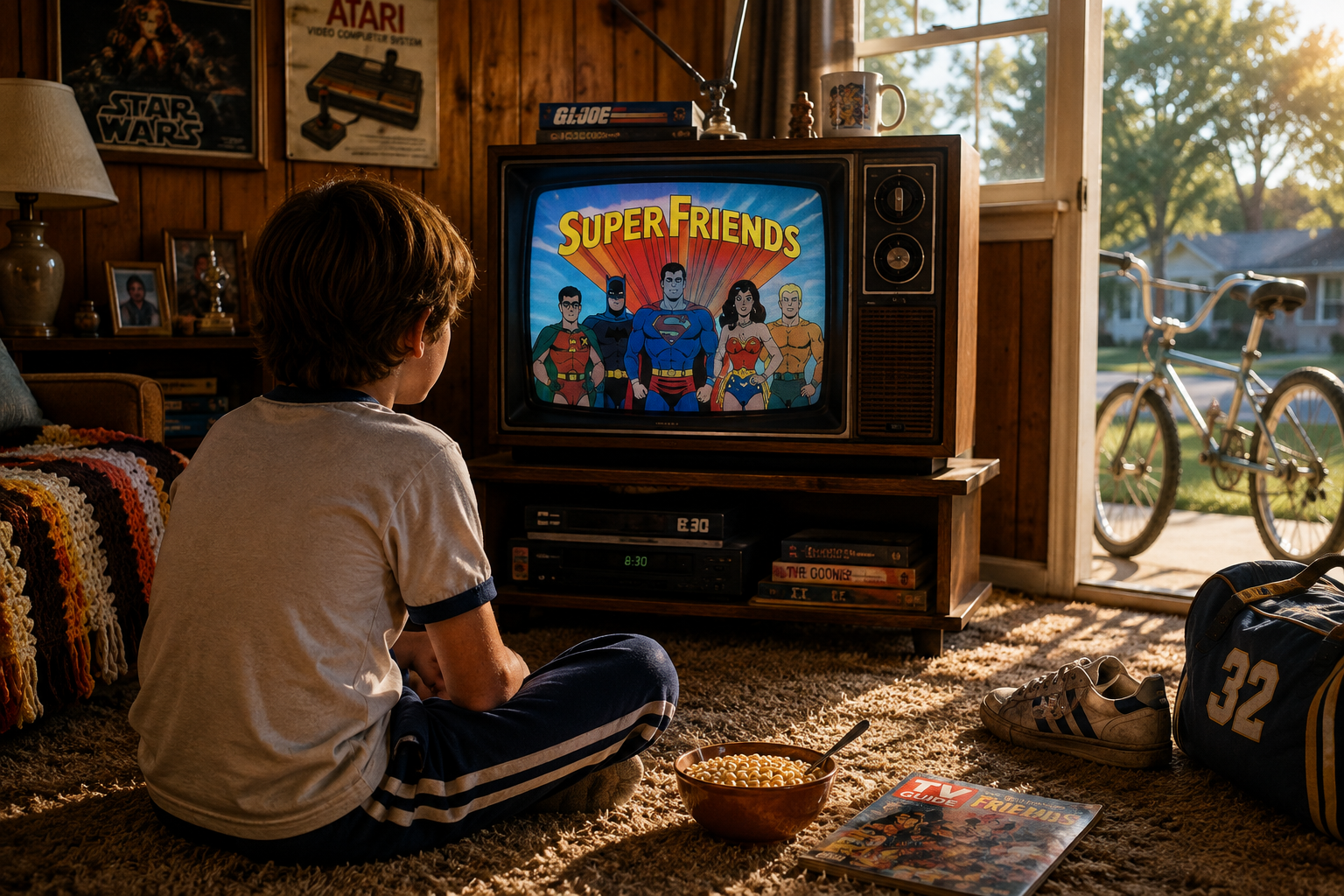
There was a time when Saturday morning had its own sound.
It was the sound of a television clicking on before the rest of the house was awake. A cereal bowl hitting the coffee table. Cartoon theme songs coming through a television speaker that wasn’t remotely capable of surround sound.
And for millions of kids who grew up in the 1970s and 1980s, Saturday morning was ours.
No streaming service. No endless library of shows waiting whenever you wanted them. No smartphone beside you. No algorithm suggesting what to watch next.
You had one chance.
If your favorite cartoon came on at 8:30 Saturday morning, you were in front of the television at 8:30 Saturday morning.
Miss it?
Too bad.
There was no rewind button.
And strangely enough, that made Saturday morning television feel more valuable than almost anything we can watch today.
The Weekly Ritual
For Gen X kids, Saturday morning often began earlier than a school day.
Think about that.
Monday morning at 7:00?
Your parents practically needed construction equipment to get you out of bed.
Saturday at 6:30?
Wide awake.
You’d creep through the house, turn on the television and wait for the cartoons to begin.
Depending on when you grew up, Saturday mornings might have included Scooby-Doo, Super Friends, The Smurfs, Fat Albert, Schoolhouse Rock!, The Bugs Bunny/Road Runner Show, Spider-Man and His Amazing Friends, The Flintstones, The Jetsons, He-Man, Transformers, G.I. Joe, Garfield and Friends and dozens of others.
The lineup changed through the years, but the ritual remained remarkably similar.
Television. Pajamas. Cereal.
And several glorious hours when adults seemed to temporarily surrender control of the television set.
Cereal Was Part of the Experience
You really can’t talk about Saturday morning cartoons without talking about cereal.
Cap’n Crunch. Froot Loops. Frosted Flakes. Lucky Charms. Cocoa Pebbles. Trix. Count Chocula.
And cereals that appeared for six months before mysteriously disappearing forever.
Nobody was carefully examining the nutrition panel.
The primary nutritional question was:
Does it turn the milk chocolate?
Better yet, there was sometimes a prize inside the box.
Not a QR code.
Not a website where you could enter a sweepstakes.
An actual plastic object buried somewhere inside the cereal.
Every kid understood the ethical dilemma that followed.
Do you patiently wait until the prize eventually pours into your bowl?
Or do you shove your entire arm into a brand-new box of cereal looking for it?
Most of us know which option won.
Commercials Were Almost as Memorable as the Shows
Saturday morning television created an advertising universe specifically designed for children.
Toy companies knew exactly where their customers were.
Sitting three feet from the television.
We saw commercials for Hot Wheels, Barbie, Star Wars figures, Stretch Armstrong, Lite-Brite, Easy-Bake Oven, Atari, Nintendo, Transformers and practically every toy imaginable.
Some commercials were so effective that a perfectly happy child could suddenly discover that life was completely meaningless without a particular toy.
Then came the inevitable campaign:
“Mom! I NEED this.”
Need was doing some very heavy lifting in that sentence.
And every December, the commercials intensified.
Christmas lists were practically written by Saturday morning television.
Then Something Educational Sneaked In
Between all those cartoons and toy commercials, something unusual happened.
We occasionally learned something.
Schoolhouse Rock! managed to teach an entire generation about multiplication, grammar, American history and government with songs that many Gen X adults can still remember decades later.
Ask somebody of a certain age how a bill becomes law and there’s a decent chance their brain immediately starts playing that famous lesson.
That is remarkable when you think about it.
Teachers spent hours trying to teach us things we promptly forgot.
A three-minute cartoon somehow stayed in our brains for fifty years.
But Saturday Morning Was Only the Beginning
Eventually the cartoons ended.
And here’s where childhood looked very different from today.
We went outside.
The television wasn’t necessarily the center of the rest of the day.
Your bicycle became transportation.
The neighborhood became your social network.
Your friends weren’t icons on a screen.
They were the kids whose houses you could reach on your bike.
You might play baseball in an empty lot, build a fort, explore a creek, shoot baskets, trade baseball cards, visit an arcade or simply ride around looking for something to do.
Parents generally didn’t know your precise location every minute.
There was often one instruction:
Be home when the streetlights come on.
And somehow, millions of us survived.
Why Does It Feel So Different Today?
Modern children have access to entertainment Gen X kids couldn’t have imagined.
Thousands of movies. Thousands of television shows. Video games connected to players around the world. YouTube. TikTok. Streaming television. Smartphones. Tablets.
Entertainment available every second of every day.
Yet unlimited choice changed something.
Saturday morning cartoons were special partly because they weren’t always available.
Anticipation mattered.
You waited all week.
Then Saturday arrived.
There is a lesson buried in that.
Sometimes scarcity creates appreciation.
When everything is available all the time, very little feels like an event.
Gen X May Have Lived Through a Unique Moment
Generation X grew up during a fascinating technological transition.
We had television, video games and increasingly sophisticated electronics.
But much of childhood was still analog.
We remember life before the internet.
Before smartphones.
Before social media.
Before streaming.
Before GPS.
Before parents could text their children every fifteen minutes.
We experienced enough technology to become fascinated by it, but enough life without technology to understand that entertainment didn’t always require a screen.
That combination may be one of the defining experiences of Generation X.
Maybe We Didn’t Know How Good We Had It
At the time, Saturday morning cartoons didn’t feel historically significant.
They were just Saturday morning.
That’s the funny thing about nostalgia.
You rarely recognize the moments you’ll miss while you’re living them.
The cereal bowls disappeared.
The bicycles were eventually parked.
The old television sets went to the curb.
The neighborhood kids grew up.
Saturday morning cartoons gradually faded as cable television, home video and eventually streaming changed how children consumed entertainment.
But somewhere inside millions of Gen X adults is still that kid sitting cross-legged on the living-room floor, cereal in hand, waiting for the next cartoon to start.
And maybe that’s why hearing an old theme song can suddenly transport us back forty years.
Not because the cartoons were necessarily better.
But because life felt different.
Saturday morning belonged to us.
And we didn’t even know enough to appreciate it.
Gen X Flashback
What was the ONE Saturday morning cartoon you refused to miss?
Join the conversation and follow The Eric Thompson Show as we revisit the culture we grew up with and explore the fascinating world we’re living in now.
Love remembering the music, television, movies, trends and everyday life we grew up with? Visit The Gen X Experience for more stories and memories from the generation that grew up analog and watched the world go digital.
LIVE CURIOUS. STAY INFORMED. FINISH WELL.