Support for Gay Marriage Declines
By ET News
For more than two decades, public support for same-sex marriage appeared to move steadily in one direction. National polling showed growing acceptance across much of American society, culminating in record-high approval levels during the early 2020s. However, new polling suggests that trend may be slowing—and even beginning to reverse.
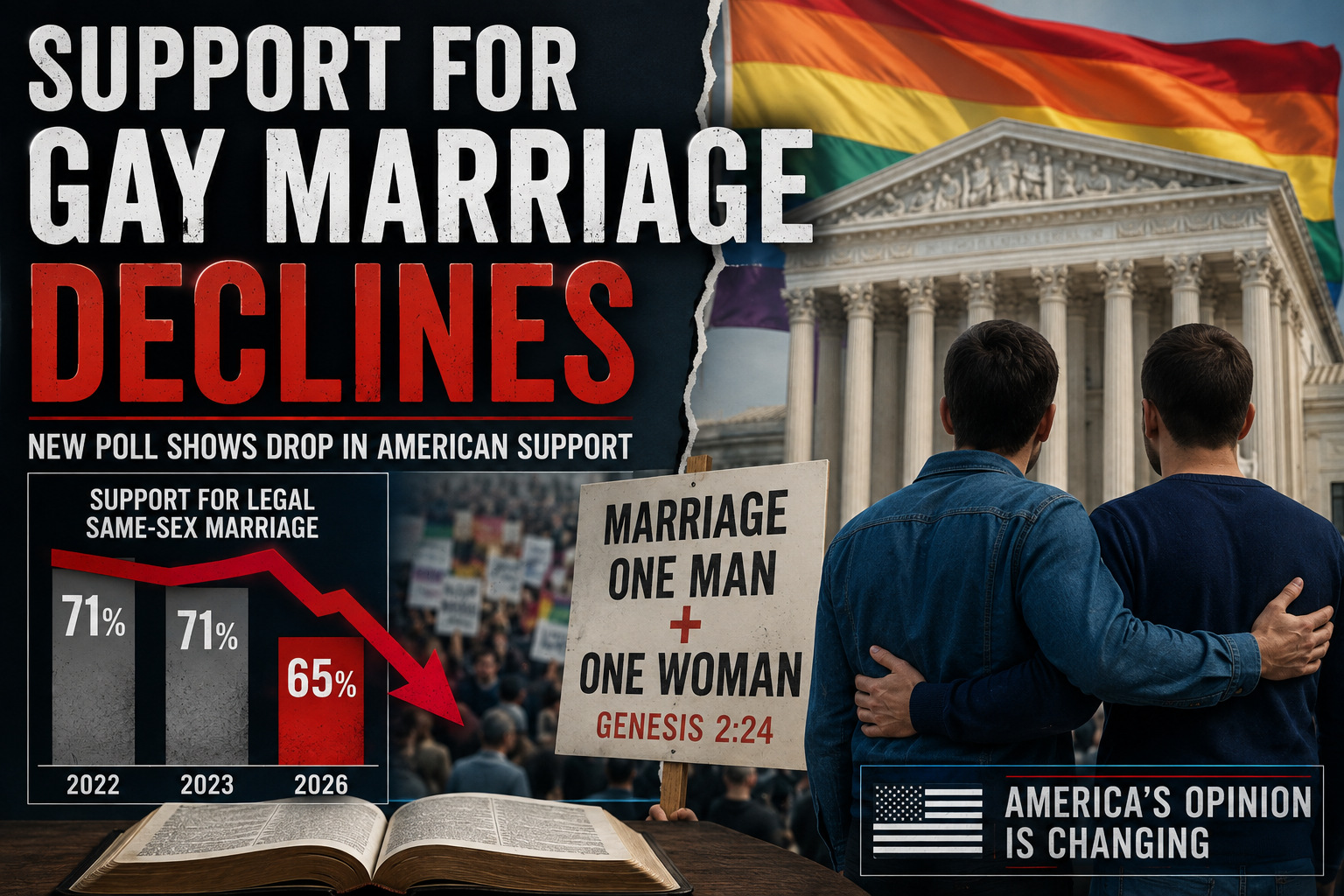
A recent Gallup survey found that 65% of Americans now support legal recognition of same-sex marriage. While that still represents a clear majority, it marks a decline from the 71% recorded in both 2022 and 2023. The results have prompted renewed discussion among political analysts, religious leaders, and cultural commentators about whether the nation is entering a new phase in the debate over marriage and family.
The poll does not suggest that Americans are abandoning support for same-sex marriage altogether. Rather, it indicates that public opinion has become more divided after years of relatively stable growth.
For many observers, the findings reflect broader cultural debates surrounding gender identity, parental rights, religious liberty, women’s sports, and education—issues that have become increasingly intertwined with discussions about sexuality over the past several years.
What the Poll Found
Gallup reported that 65% of Americans believe marriages between same-sex couples should be recognized as legally valid. Although still a majority, that figure represents the third consecutive annual decline from the record highs reached earlier in the decade.
The survey also found that 62% of Americans now consider same-sex relationships to be “morally acceptable,” the lowest level Gallup has recorded since 2016.
Political affiliation remains one of the strongest predictors of opinion.
Support among Democrats remains overwhelmingly high, while Republican support has declined substantially over the past several years. Independent voters continue to express majority support, although their numbers have also softened somewhat.
Gallup’s polling indicates that much of the recent decline has occurred among Republican voters rather than across the electorate as a whole.
Why Opinions May Be Changing
Polling experts caution that surveys measure public opinion but cannot always explain why attitudes change.
Nevertheless, analysts point to several possible factors.
Over the past several years, national attention has shifted from the legal recognition of same-sex marriage toward broader debates involving transgender policies, youth medical treatments, school curricula, women’s athletics, parental notification laws, and religious freedom protections.
Some political observers believe many Americans now view these issues as interconnected, influencing their responses when asked about broader questions involving sexuality and public policy.
Others argue that increased political polarization has encouraged voters to return to more traditional positions on a range of cultural issues.
At the same time, supporters of same-sex marriage continue arguing that civil marriage protections should remain available equally to all consenting adults regardless of sexual orientation.
The differing perspectives illustrate how complex the national conversation has become.
A Continuing Cultural Debate
The Supreme Court’s 2015 decision in Obergefell v. Hodges legalized same-sex marriage nationwide.
Since that ruling, legal recognition of same-sex marriage has remained unchanged despite continued political disagreement.
The latest Gallup findings therefore represent a shift in public opinion rather than a change in federal law.
Many legal scholars expect the issue to remain politically relevant because questions involving religious liberty, free speech, adoption agencies, education, and employment continue appearing before state legislatures and federal courts.
Those debates often extend beyond marriage itself and involve how competing constitutional rights should be balanced within a diverse society.
Americans Remain Deeply Divided
Although a majority still supports legal same-sex marriage, the polling demonstrates that Americans continue holding widely different moral and religious convictions.
Faith communities generally continue teaching the historic doctrines of their respective traditions, while many secular organizations advocate broader legal and cultural acceptance.
Public officials therefore face ongoing challenges as they attempt to balance constitutional protections involving religious liberty, freedom of speech, equal protection, and civil rights.
The latest polling suggests that these discussions are far from settled.
Why This Matters
Marriage has long been recognized as one of society’s foundational institutions.
Changes in public attitudes toward marriage often influence conversations involving family policy, education, religious organizations, adoption services, healthcare, and constitutional law.
Whether Americans support or oppose same-sex marriage, few would dispute that marriage continues to shape communities, child-rearing, and social stability.
As public opinion evolves, lawmakers, churches, schools, businesses, and families will likely continue navigating difficult questions involving both conviction and coexistence.
ET News Analysis
Christians should approach these polling results with both humility and conviction.
Scripture teaches that marriage was established by God as a lifelong covenant between one man and one woman. That understanding has been consistently affirmed throughout both the Old and New Testaments and has formed the historic teaching of the Christian Church for nearly two thousand years.
At the same time, Christians are called to treat every person with dignity, compassion, and respect because every human being is created in the image of God. Cultural disagreements should never become excuses for hatred, cruelty, or personal hostility.
The latest Gallup poll does not determine biblical truth, nor does it settle moral questions. Polls simply measure public opinion at a particular moment in history. Christians ultimately look to Scripture—not opinion surveys—as the final authority for faith and practice.
Believers should continue speaking the truth in love, defending religious liberty, strengthening biblical marriages, supporting healthy families, and extending the grace of Christ to everyone regardless of background or personal struggles.
Our culture may continue changing, but the Christian calling remains the same: proclaim truth faithfully while demonstrating Christlike love toward our neighbors.
“Have you not read that He who created them from the beginning made them male and female… For this reason a man shall leave his father and his mother and be joined to his wife, and the two shall become one flesh.”
— Matthew 19:4–6 (NASB 1995)
Pastor Alistair Begg has often reminded Christians that biblical conviction and genuine compassion must never be separated. The Church is called to uphold God’s design for marriage while extending the hope of the Gospel to every person. In a culture of increasing division, believers should be known for both unwavering commitment to biblical truth and sincere Christlike love.