
Water is one of America’s most essential resources. Every day, millions of Americans rely on local water systems for drinking, cooking, sanitation, healthcare, agriculture, and industry. Most people rarely think about the complex technology operating behind the scenes—until something goes wrong.
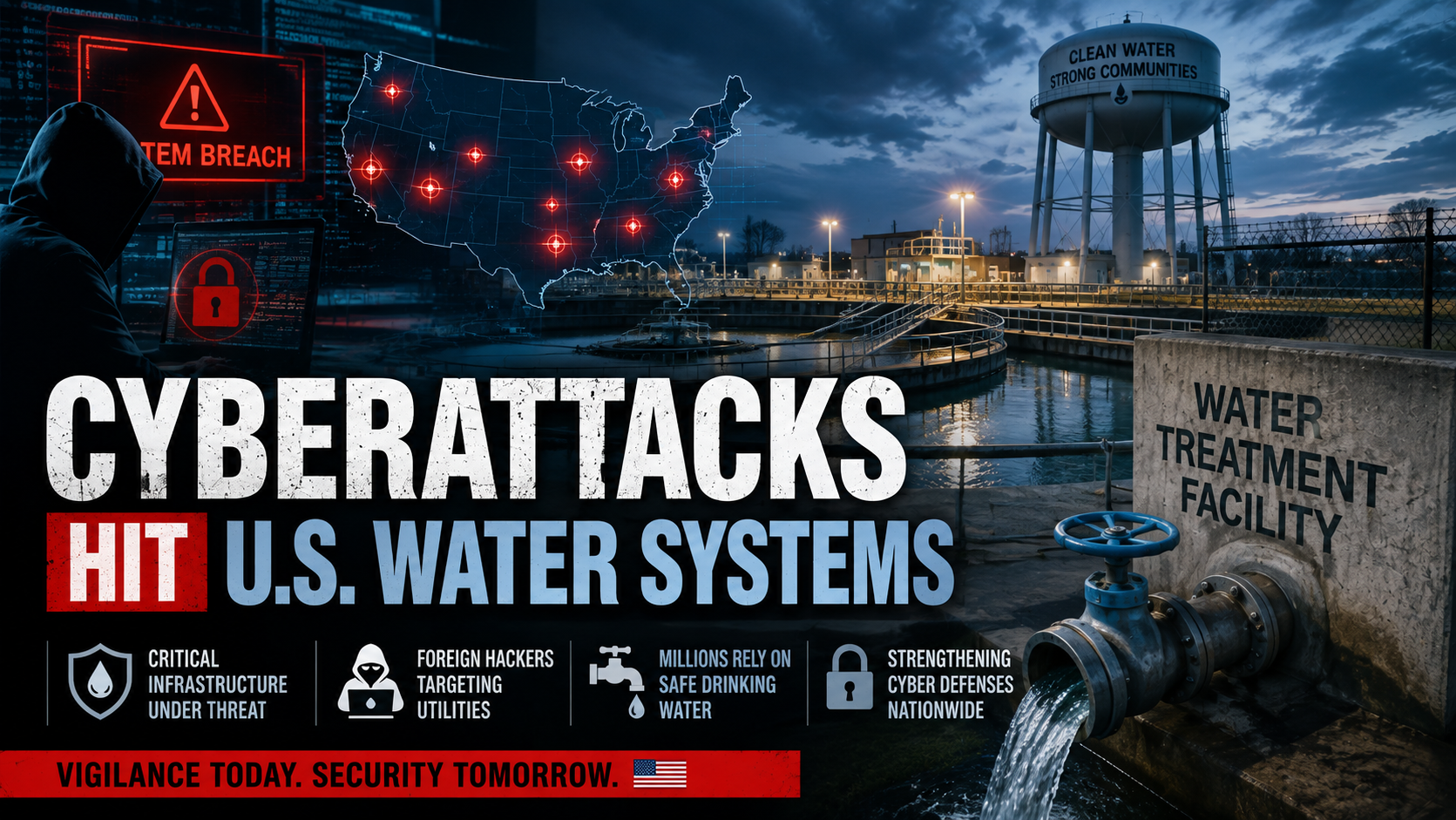
Federal cybersecurity officials are warning that America’s water infrastructure is increasingly becoming a target for foreign hackers. Recent cyberattacks affecting water utilities across multiple states have renewed concerns that hostile governments and criminal organizations are probing America’s critical infrastructure for weaknesses that could one day disrupt essential public services.
While many of the recent attacks were detected before causing widespread harm, cybersecurity experts say they serve as another reminder that the nation’s water systems remain attractive targets in an era of growing international cyber conflict.
The issue extends far beyond computer networks. It involves national security, public safety, and the resilience of infrastructure that Americans depend on every day.
Why Water Systems Are Being Targeted
Modern water utilities rely on computerized industrial control systems to operate pumps, treatment facilities, storage tanks, pressure controls, chemical treatment processes, and distribution networks.
These systems allow operators to monitor equipment remotely and respond quickly to changing conditions. However, increased connectivity also creates opportunities for cybercriminals and hostile foreign actors seeking to gain unauthorized access.
Federal officials have repeatedly warned that adversarial governments—including Iran, China, Russia, and others—have demonstrated both the capability and the willingness to target American infrastructure during periods of heightened geopolitical tension.
Unlike traditional military attacks, cyber operations can be conducted remotely, often with limited cost and varying degrees of plausible deniability.
Recent Cybersecurity Incidents
Over the past two years, federal agencies have reported multiple cybersecurity incidents involving water utilities throughout the United States.
Some attacks have been attributed to criminal ransomware groups seeking financial gain. Others have been linked by investigators to state-sponsored or state-affiliated hacking organizations operating on behalf of foreign governments.
Federal investigators say some attackers have attempted to gain access to operational technology that controls water treatment and distribution systems.
Although many utilities have prevented significant damage through rapid detection and response, cybersecurity experts warn that even unsuccessful attacks provide valuable information to adversaries studying America’s infrastructure.
Each attempted intrusion helps hostile actors identify weaknesses they may attempt to exploit in future operations.
America’s Aging Infrastructure
One reason many experts remain concerned is the age of America’s infrastructure.
Many local water utilities serve relatively small populations with limited budgets and small technology staffs.
Unlike large financial institutions or major technology companies, smaller municipal utilities often lack dedicated cybersecurity teams capable of continuously monitoring sophisticated cyber threats.
Some facilities continue operating equipment originally designed decades ago—long before today’s cybersecurity challenges existed.
Modernizing those systems requires significant investment, specialized expertise, and ongoing maintenance.
National Security Implications
Cybersecurity experts increasingly view infrastructure attacks as part of a broader strategy used by adversarial nations.
Rather than immediately disrupting services during peacetime, foreign intelligence agencies may seek to establish persistent access to critical infrastructure for potential future use.
In the event of a major international conflict, pre-positioned cyber capabilities could theoretically be used to disrupt communications, transportation, utilities, financial systems, or other essential services.
For that reason, protecting water systems has become an important component of America’s overall homeland security strategy.
Federal agencies continue working with state governments and local utilities to improve cybersecurity training, share threat intelligence, strengthen incident response capabilities, and encourage stronger network protections.
What Utilities Are Doing
Water providers across the country are increasing cybersecurity investments.
Many utilities have adopted multi-factor authentication, improved network segmentation, increased employee cybersecurity training, strengthened software update procedures, and expanded cooperation with federal agencies.
Emergency response plans now frequently include cybersecurity scenarios alongside traditional natural disasters and equipment failures.
Industry organizations continue encouraging utilities to perform regular security assessments and develop contingency plans for maintaining operations if computer systems become unavailable.
While no system can be made completely immune from cyber threats, experts agree that preparation significantly reduces risk.
Why This Matters
Cyberattacks against water utilities illustrate how modern warfare is changing.
Future conflicts may not begin with conventional military operations. They could involve simultaneous attacks against communications, energy systems, transportation networks, healthcare providers, financial institutions, and public utilities.
Protecting infrastructure therefore requires more than military strength. It demands cooperation between government, private industry, cybersecurity professionals, engineers, and local communities.
Americans often take reliable utilities for granted until disruptions occur. Recent cyber incidents serve as reminders that protecting those systems requires constant vigilance.
ET News Analysis
Christians should recognize that government has a legitimate responsibility to protect its citizens from external threats. Securing critical infrastructure—including water, electricity, transportation, and communications—is an important part of that responsibility.
At the same time, cybersecurity should not become an excuse for unnecessary government secrecy or expanded surveillance unrelated to genuine security needs. Americans rightly expect both safety and accountability from public officials.
The growing sophistication of cyber threats also reminds believers that technology alone cannot guarantee security. Human wisdom, integrity, preparedness, and responsible leadership remain essential.
Communities should support reasonable investments that strengthen infrastructure while insisting that taxpayer resources be managed carefully and transparently. Preventing attacks before they occur is often far less costly than recovering after a successful breach.
Ultimately, America’s strength depends not only upon advanced technology but also upon leaders willing to exercise sound judgment, responsible stewardship, and vigilance in protecting the nation.
“If the watchman sees the sword coming and does not blow the trumpet… I will require his blood from the watchman’s hand.”
— Ezekiel 33:6 (NASB 1995)
John MacArthur has often taught that Scripture calls leaders to faithfully protect those under their care. While no earthly government can eliminate every threat, officials entrusted with protecting critical infrastructure should act diligently, honestly, and responsibly. The increasing number of cyberattacks against essential services should serve as a reminder that vigilance is not optional—it is part of faithful stewardship.