

Artificial intelligence may be one of the most consequential technological developments of our lifetime. It has the potential to transform medicine, manufacturing, education, transportation, national defense, small business, and nearly every industry in America.
But artificial intelligence does not live somewhere in an invisible “cloud.”
It lives in buildings.
Very, very large buildings.
Across America, enormous data centers are being proposed and constructed to house the servers and computing infrastructure required to power the AI revolution. And increasingly, the people who actually live in the communities where these facilities are being built are asking a simple question:
What’s in this for us?
That question is creating an unusual political movement.
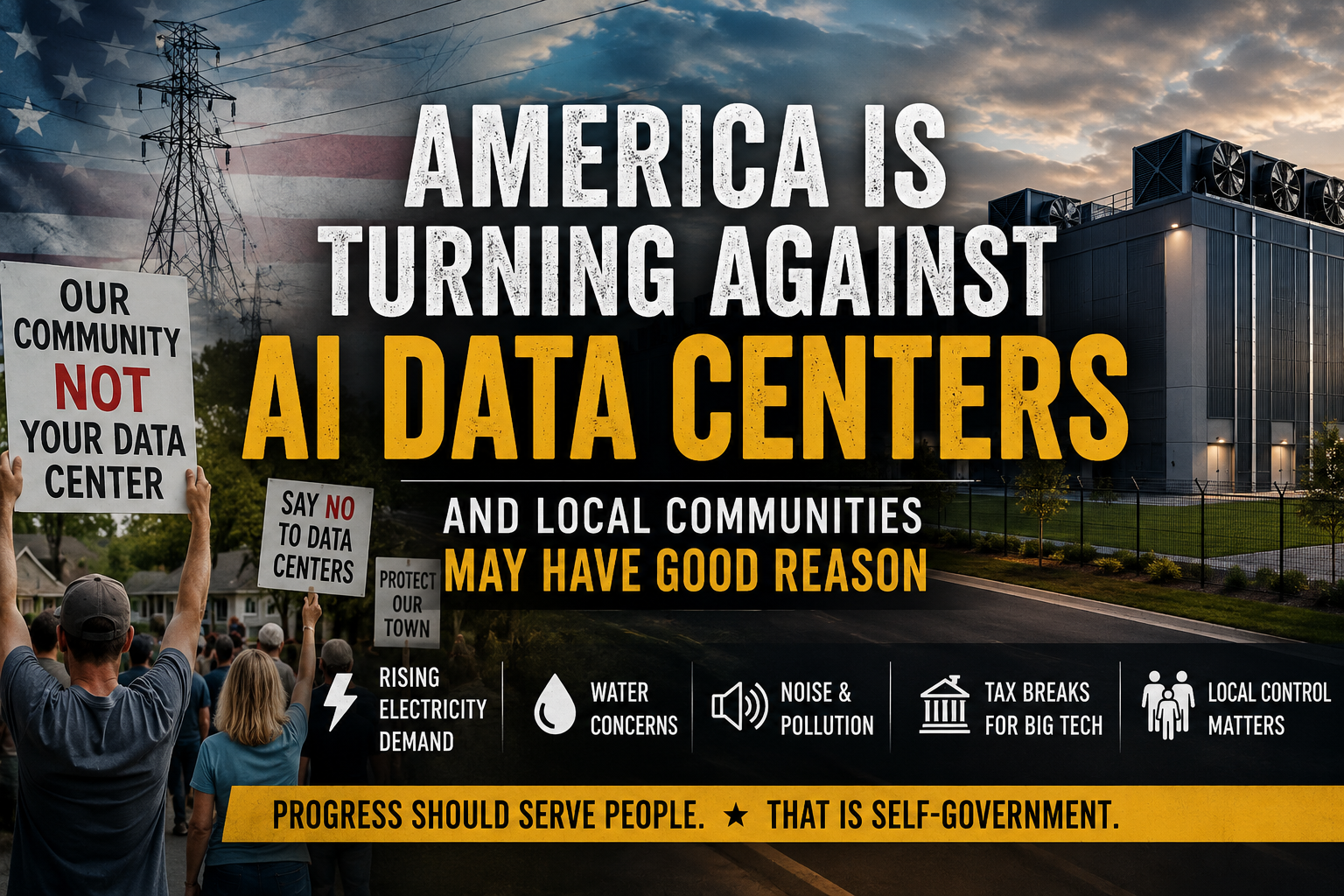
Americans who may disagree about almost everything else are beginning to push back against massive data-center projects over electricity demand, water consumption, noise, tax incentives, transparency, and the long-term effect these facilities could have on their communities.
Recent national reporting has shown that opposition to data centers is becoming a significant political issue, especially as local residents begin questioning how much of the cost and disruption they may be expected to absorb.
This is not merely another fight over technology.
It raises a much older American question:
Who should decide what happens to a community — the people who live there, or powerful institutions far removed from it?
The Enormous Appetite for Electricity
The first thing Americans need to understand is the staggering amount of infrastructure behind AI.
The U.S. Energy Information Administration has reported that electricity demand is rising again after more than a decade of relatively little growth, and data centers are among the major drivers.
Between 2020 and 2025, U.S. electricity demand grew much faster than it had during the previous decade and a half. Servers are already consuming a growing share of commercial electricity use, and projections suggest that demand could rise dramatically over the next several decades.
That does not mean America should stop building data centers.
It means Americans deserve an honest conversation about what building them requires.
If a multibillion-dollar technology company needs enormous amounts of additional electricity, who pays to expand the electrical infrastructure?
Should existing homeowners and small businesses see their utility bills rise?
Should taxpayers subsidize infrastructure primarily benefiting some of the wealthiest corporations in history?
Those are not anti-technology questions.
They are free-market questions.
Local Control Versus Corporate Power
Conservatives have traditionally defended property rights, federalism, and government closest to the people.
The data-center debate provides an important test of those principles.
A community should not oppose economic development merely because something is new. Private investment, technological innovation, and American entrepreneurship have created extraordinary prosperity.
But free enterprise is not the same thing as corporate privilege.
If a project is economically viable only because politicians provide enormous tax incentives, preferential infrastructure arrangements, or other special treatment, citizens have every right to examine the deal.
And if government officials negotiate major projects without meaningful public transparency, residents have every right to demand answers.
One of the most interesting aspects of the current backlash is how local it has become.
Communities are debating whether data centers should pay for electrical upgrades, disclose water requirements, control noise, protect surrounding property owners, and provide tangible economic benefits to the communities hosting them.
Those demands are not radical.
They are remarkably traditional.
Then There Are the Jobs
Supporters of data centers have a legitimate argument.
These projects can represent billions of dollars in investment. Construction can employ large numbers of workers. They can expand the tax base, stimulate supporting businesses, and provide infrastructure improvements.
And America should absolutely want advanced AI infrastructure being built here rather than in China.
The United States cannot simultaneously demand leadership in artificial intelligence while refusing to build the physical infrastructure required to achieve it.
China is not going to stop developing AI because Americans are uncomfortable with server farms.
National security has to be part of this discussion.
But so does the difference between temporary construction employment and permanent local jobs.
Communities should receive clear numbers before granting extraordinary concessions.
How many permanent employees will actually work at the facility?
What will those jobs pay?
How much tax revenue will remain locally?
What additional infrastructure will be required?
Who pays for it?
Those questions should be answered before the bulldozers arrive.
Oklahoma Is Part of This Story
This issue is not theoretical for Oklahoma.
Recent national attention has focused on proposed and expanding data-center projects in communities across the state, including concerns about land use, energy, water, infrastructure, and whether residents are being given enough information before major agreements move forward.
That should get our attention.
Oklahoma wants economic development. We want technology companies investing here. We want good jobs, new industries, and opportunities that keep our children and grandchildren in the state.
But welcoming investment does not require writing corporations a blank check.
The proper question is not:
“Are you for data centers or against them?”
That is too simplistic.
The better question is:
Under what conditions does a data center genuinely benefit the community that hosts it?
A Conservative Approach to the AI Infrastructure Boom
There is a reasonable path between blindly approving every data center and attempting to stop technological progress.
Start with transparency.
Before local government approves a massive project, residents should know the expected electricity demand, water requirements, infrastructure costs, tax arrangements, and projected permanent employment.
Second, protect taxpayers.
The ordinary homeowner should not be forced to subsidize the electricity infrastructure of a corporation worth hundreds of billions — or trillions — of dollars.
Third, protect property rights.
Noise, industrial development, and infrastructure should not effectively destroy the enjoyment or value of neighboring private property without serious consideration.
Fourth, demand genuine economic benefit.
If politicians offer incentives, taxpayers deserve measurable returns.
And finally, America must build enough energy.
This may be the biggest lesson of all.
AI, advanced manufacturing, electric transportation, semiconductor production, and a growing population all require electricity. America cannot become the world’s technological leader while pretending electricity simply appears when someone flips a switch.
That should trigger a national conversation about abundant, reliable American energy — including nuclear power, natural gas, and other economically viable sources capable of supporting a modern industrial economy.
The Bigger Issue Is Not Really the Buildings
America should lead the world in artificial intelligence.
We should want American companies — not the Chinese Communist Party — developing the technologies that may define the next century.
But technological leadership and local self-government do not have to be enemies.
The growing data-center rebellion may actually be Americans rediscovering something fundamental:
Progress should serve people. People should not simply be expected to serve progress.
A healthy free society does not tell citizens to get out of the way because powerful corporations and government officials have already decided what is best for them.
It asks questions.
It demands transparency.
It protects private property.
It requires government to justify the use of taxpayer resources.
And ultimately, it remembers that America’s communities belong first to the people who call them home.
That is not anti-AI.
That is self-government.