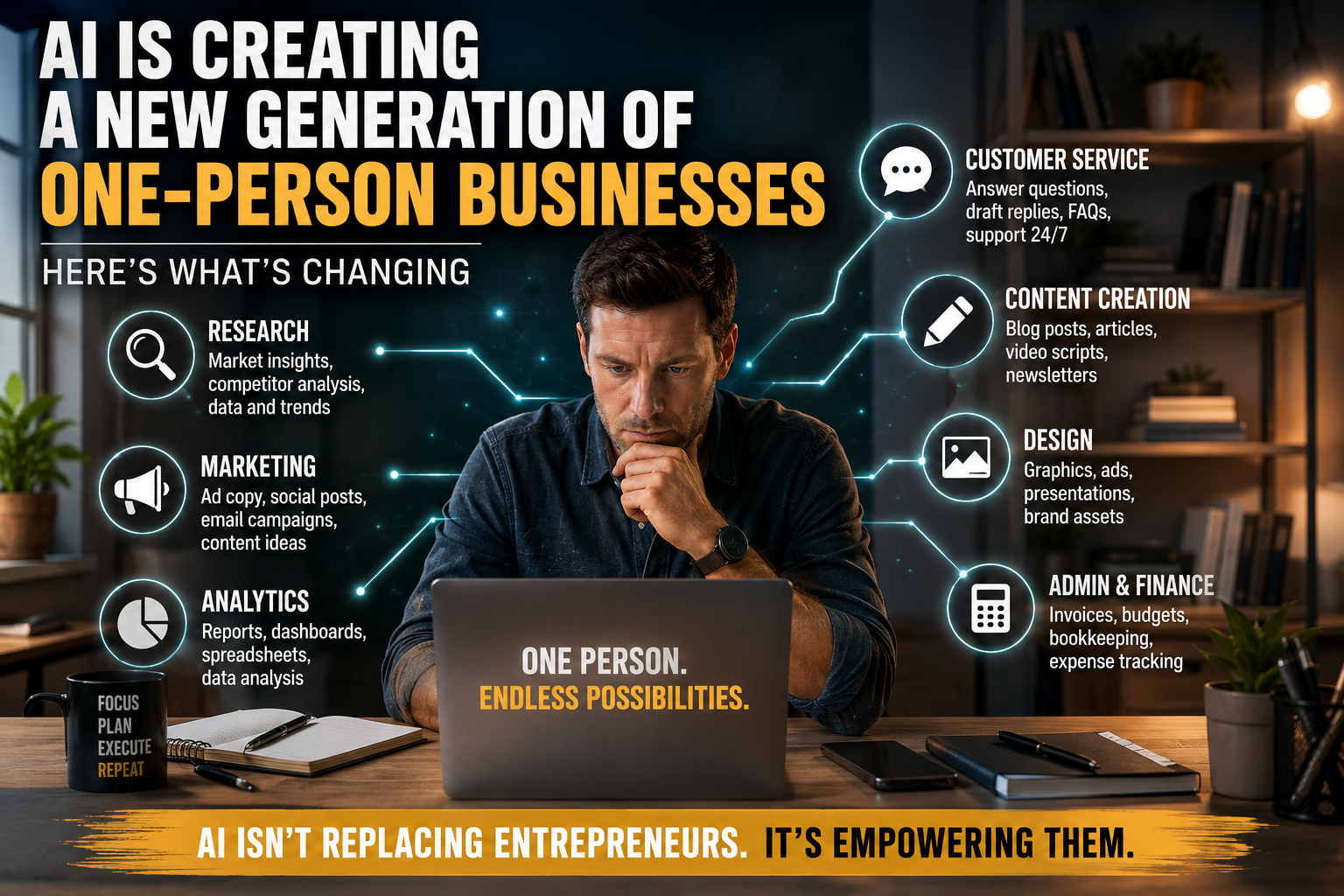
What if starting a business no longer required hiring a team before you could seriously compete?
For generations, growing a company usually meant adding people.
You needed someone to answer customers.
Someone to handle marketing.
Someone to design advertisements.
Someone to research competitors.
Someone to update the website.
Someone to write sales material.
Someone to organize the books, analyze the numbers and keep dozens of small administrative tasks from consuming the owner’s day.
Artificial intelligence is beginning to change that equation.
Not because AI can magically build a successful company for you.
It can’t.
But because one capable person can increasingly accomplish work that once required several employees, freelancers, agencies or specialized software systems.
And that could quietly produce one of the most interesting business shifts of the AI era:
The rise of the AI-powered one-person company.
This Isn’t Just a Silicon Valley Story
When people hear “AI entrepreneur,” they may picture a programmer building the next technology startup.
But something much broader is happening.
AI is being used by consultants, contractors, online retailers, home-service companies, restaurants, creators, professional services firms and ordinary people trying to turn an idea into a business.
OpenAI reported in May 2026 that at least four million people in the United States had used ChatGPT during March alone to help plan, start, operate or grow a business.
Most weren’t starting artificial-intelligence companies.
They were using AI as a tool inside otherwise ordinary businesses.
That’s an important distinction.
The biggest small-business impact of AI may not come from people selling AI.
It may come from people using AI to become more capable at whatever they already do.
The Owner Who Used to Wear Five Hats Can Now Wear Ten
Anyone who has operated a small business knows the reality.
Your title might say “Owner.”
Your actual job description looks more like this:
Salesperson.
Marketer.
Customer-service representative.
Researcher.
Copywriter.
Bookkeeper.
Operations manager.
Technology department.
And occasionally janitor.
Small-business owners have always worn multiple hats.
AI is beginning to make some of those hats considerably easier to wear.
What Can One Person Actually Do With AI?
Forget the science-fiction predictions for a moment.
Look at the ordinary work businesses already perform every day.
A business owner can use AI to help research a market, summarize industry information, brainstorm products, prepare customer FAQs, draft marketing campaigns, analyze spreadsheets, create first drafts of proposals, develop social-media ideas, organize meeting notes, prepare website copy and generate variations of advertisements.
AI can help turn one long piece of content into an email, social post, video outline and newsletter.
It can help a business owner analyze customer questions and discover patterns.
Increasingly capable AI agents can also execute multi-step digital workflows rather than merely providing an answer.
That doesn’t eliminate the owner.
It changes where the owner spends time.
The Economics Are What Make This So Important
Imagine an entrepreneur with a good business idea but only a few thousand dollars available to get started.
Historically, limited capital placed enormous constraints on what that person could accomplish.
A professional website cost money.
Graphic design cost money.
Copywriting cost money.
Market research cost money.
Administrative help cost money.
Software development could cost a fortune.
Many of those costs haven’t disappeared.
But the barrier to producing a competent first version of the work has fallen dramatically.
A determined entrepreneur can now sit at a kitchen table and access capabilities that would have been difficult or expensive for a small company to obtain only a few years ago.
That doesn’t guarantee success.
But it lowers the price of trying.
And when the price of trying falls, more people can become entrepreneurs.
We’re Already Seeing the Shift
The exact percentage of American businesses using AI varies considerably depending on how researchers define “using AI.”
That’s worth acknowledging because you’ll encounter dramatically different numbers online.
U.S. Census Bureau data covering late 2025 through spring 2026 found roughly 17% to 20% of businesses reporting AI use across business functions.
Other surveys asking broader questions have reported substantially higher adoption.
A 2026 U.S. Bank survey, for example, reported that 75% of surveyed small businesses were using generative AI in some capacity.
The specific numbers vary.
The direction doesn’t.
AI is moving into everyday business.
Marketing Is One of the First Places It’s Happening
This makes sense.
Small businesses frequently struggle to produce enough marketing material.
The owner knows the business but may not know how to write an advertisement, construct an email campaign or develop a month of social-media ideas.
AI dramatically reduces the time required to create a first draft.
Recent Census research found that among businesses already adopting AI, sales and marketing was the most commonly reported business function using it.
Strategy and business development and information technology were also among the leading uses.
Other small-business research has identified uses including communications, graphic design, customer service, analytics, forecasting and productivity work.
But Here’s Where the AI Hype Goes Wrong
There’s an enormous difference between:
AI can help operate a business.
and:
AI can build a successful business while you sit on the beach.
The first statement is increasingly true.
The second belongs in the same category as decades of “get rich while you sleep” advertisements.
Businesses still need customers.
Customers still need a reason to choose you.
You still need a useful product or service.
You still need judgment.
You still need credibility.
And when something goes wrong, telling an angry customer that “the AI did it” probably isn’t going to help.
AI Makes Expertise More Important, Not Less
There is another problem that doesn’t receive enough attention.
AI can be confidently wrong.
It can misunderstand instructions.
It can generate bland marketing.
It can invent information.
And automation can make mistakes faster than humans ever could.
That’s why expertise becomes so valuable.
If you’re an experienced electrician using AI to help organize customer communications, you know when the AI says something ridiculous about electrical work.
If you’re an experienced accountant, attorney, mechanic or marketer, you have the knowledge necessary to evaluate the output.
Someone who knows nothing about the subject may not recognize the mistake.
AI doesn’t eliminate the value of knowing what you’re doing.
It can multiply the value of knowing what you’re doing.
Five Ways a Small Business Can Start This Week
You don’t need to “transform your company with AI.”
That’s consultant language.
Start with something annoying.
1. Find one repetitive task.
What do you repeatedly type, research, organize or summarize?
Start there.
2. Build a customer FAQ.
Gather the questions customers repeatedly ask and use AI to help organize clear answers. Review every answer yourself before publishing it.
3. Improve your marketing workflow.
Instead of asking AI to “write me an ad,” give it information about your actual customers, services and differentiators. Use the result as a draft and rewrite it in your voice.
4. Use AI as a research assistant.
Have it help identify questions to investigate, summarize material you provide and organize information—but verify important facts against reliable sources.
5. Measure whether it actually saves time.
This may be the most important step.
Don’t use AI because everyone says you’re supposed to.
If a task previously took two hours and now takes twenty minutes with equal or better quality, you’ve found something useful.
If you spend two hours correcting the AI’s mistakes, you haven’t.
Will We Really See Million-Dollar One-Person Companies?
We already have highly successful solo businesses.
AI could make them considerably more common.
Think about the combination now becoming available to one entrepreneur:
Global online distribution.
Digital payments.
Cloud software.
On-demand manufacturing.
Freelance marketplaces.
Social-media distribution.
AI-assisted programming.
AI-assisted marketing.
AI-assisted administration.
And increasingly autonomous AI agents.
None of those technologies guarantees that anybody will buy what you’re selling.
But together they allow extraordinarily small organizations to operate with capabilities once associated with much larger companies.
The Bigger Question Isn’t Whether AI Takes Jobs
Job displacement is a legitimate concern and deserves serious discussion.
But there’s another side of the equation.
What businesses become possible because AI exists?
What if someone who could never afford a marketing department can now market effectively?
What if a tradesman who hates paperwork can spend more time practicing his trade?
What if a talented person who couldn’t afford employees can finally turn an idea into a viable company?
What if the smallest American businesses become considerably more productive?
Those possibilities deserve just as much attention as the predictions of what AI might destroy.
The One-Person Company Isn’t Really One Person
And maybe that’s the best way to understand what is happening.
The entrepreneur is still one human being.
But that person increasingly has access to something resembling an on-demand research assistant, junior copywriter, analyst, brainstorming partner, designer and technical helper.
Not perfect employees.
Not replacements for every professional.
Tools.
Extremely powerful tools.
The entrepreneurs who succeed probably won’t be the people who hand their entire businesses over to artificial intelligence.
They’ll be the people who figure out something much more important:
What should the machine do—and what should only the human do?
That distinction may define the next generation of American small business.
What part of your work would you hand to AI tomorrow if you knew it could do the job reliably?
That’s a conversation we’re going to keep exploring on The Eric Thompson Show as artificial intelligence changes business, work and everyday American life.
LIVE CURIOUS. STAY INFORMED. FINISH WELL.